Tuesday, August 11, 2020

How to Nurture B2B Influencer Relationships During the Pandemic

Two glove-covered hands fist-bumping image.

Two glove-covered hands fist-bumping image. I’m so glad that I went to B2BMX this past February. For one thing, we did some amazing interviews with some very smart marketers. The very idea of these interviews seems weird now — we were just sitting! Three feet apart! With no masks! At a giant marketing conference at a hotel! The cancellation of in-person events means I’ll miss one or two conferences this year. But for folks who make a living as keynote speakers and thought leaders, it’s a massive adjustment. And that includes a sizable subset of B2B influencers — those who are primarily keynote speakers and in-person consultants. As an agency, we’re true believers in B2B influencer marketing (see our latest report to learn why). But we have had to adjust our strategy as influencers’ needs change. Like everything else in 2020, influencer relationship-building takes a different approach than you might be used to. Debbie Friez is an Influencer Marketing Strategist at TopRank Marketing, and she’s an expert at finding the right influencers and developing ongoing relationships. Here’s what Debbie and I have observed and how we’ve changed our outreach strategy.

How to Nurture B2B Influencer Relationships During the Pandemic

Influence relationships operate by much the same rules as any friendship: Get to know the person, don’t talk about yourself too much, give something before you ask for anything, and be sensitive to their emotions and needs. And, of course, don’t propose marriage on the first date (unless it’s going REALLY well). On top of those rules, here are a few ways to adjust your approach for the current crisis. [bctt tweet="“Influence relationships operate by much the same rules as any friendship: Get to know the person, don’t talk about yourself too much, give something before you ask for anything, and be sensitive to their emotions and needs.” @NiteWrites" username="toprank"]

#1: Scale Back Your Requests

It’s easy to imagine that influencers have nothing but free time right now. After all, they’re not traveling as much, and all the events are virtual — that means they should have ample time to write a blog post or film a webinar, right? What we’ve seen, however, is the opposite is true. Those who make a living at public speaking are hustling harder than ever. “Now that all the events are virtual, there is a disconnect between how influencers are compensated,” says Debbie. Instead of a 90-minute in-person talk, influencers might need to do a dozen webinars to make ends meet. Now is a good time to focus on micro-content — keep the requests down to 50-100 words. Where you might have asked one influencer for a 500-word blog, ask three influencers the same question and do a roundup of their answers. Or focus on social-first content that can be bite-sized but still foster engagement. Simply put, it’s more important than ever to respect influencers’ time and make sure your requests are appropriate. Speaking of which… [bctt tweet="“It’s more important than ever to respect influencers’ time and make sure your requests are appropriate.” @NiteWrites" username="toprank"]

#2: Offer a Good Value Exchange

Every good influencer relationship is based on a value exchange. You’re giving the influencer something they want, and getting something you want in return. When you build relationships for long-term, always-on influencer marketing, that value exchange tends to be in terms of co-creating awesome content together, exposure to each others’ audience, and other non-monetary benefits. However, direct compensation is always part of the influencer marketing toolkit. Right now, influencers may see less value in co-creation and be looking for more ways to supplement their income. “Frequently, influencers would co-create content for free, as they were taking payment to speak at or attend events,” Debbie says. With events on pause, it’s important for influencer marketers to budget for the right type of compensation.

#3: Be Empathetic 

As you might have noticed, it’s rough out in the world right now. Odds are you’re stressed out, concerned about keeping your family safe and the bills paid. You may even have scaled back on your social media and focused more energy inward.  Influencers are no different. It’s important that your outreach be warm (no blind InMail requests or impersonal emails), sympathetic, and respectful. Just as you’ve adjusted your content marketing to meet your audience’s current mental state, make sure your influencer outreach is appropriate for the times.

#4: Offer Creative Opportunities

Odds are any influencer you reach out to has done multiple webinars, guest blogs, and livestreams in the past six months. And they’re likely filling their calendars with as many more gigs as they can get. What can you offer an influencer that will get their attention? Now is a good time to pitch fun, creative ideas for content. How about a brief interview that you’ll turn into a fully-produced podcast, complete with background music and sound design? Or a short contribution that will be featured in a dynamic, interactive asset? The easier you can make the ask, and the cooler you can make the end product, the better.

#5: Explore Always-On Influence

As you’ve seen, it can be challenging to establish relationships with influencers right now. People are busy, distracted and stressed, and it’s easy for your messages to get lost in the shuffle. It’s not impossible, of course, to add net new influencers to your marketing — it just takes more effort. Right now, brands that have ongoing influencer nurturing programs are doing better than those without. It’s easy to see why — they’re not starting from scratch. They have built up a community of influencers over time, co-creating content, helping each other out, even introducing influencers to each other to help them network. It’s easier to maintain an ongoing relationship than start a brand new one. [bctt tweet="“Right now, brands that have ongoing influencer nurturing programs are doing better than those without. It’s easy to see why — they’re not starting from scratch.” @NiteWrites" username="toprank"]

Relationships Are Worth the Work

We surveyed hundreds of marketers for our 2020 State of B2B Influencer Marketing report. The vast majority said that influencer marketing works for B2B: 74% agree that influencer marketing improves customer and prospect experience with the brand, and 90% plan to increase their budget in the near future.  While the current business climate may make it more challenging to develop influencer relationships, the results are well worth the effort.  Need help with B2B influencer marketing? It’s our specialty.

The post How to Nurture B2B Influencer Relationships During the Pandemic appeared first on Online Marketing Blog - TopRank®.

Monday, August 10, 2020

In Search of Trust: How Authentic Content Drives Customer Experience

Authentic Content Customer Experience

Authentic Content Customer Experience The experience customers have through marketing content can be one of the most important differentiators for brands today. And yet 58% of B2B buyers don't not believe claims made by the vendors they most recently bought from (TrustRadius). It’s hard to create a great experience if customers don’t trust brand communications. Trust is the gateway to influence perceptions, behaviors and actions and brands that want to succeed in the uncertain environment of today’s digital world need to double down on building trust with their customers. But how? Today’s increasingly digital buyers have high expectations of the companies they do business with: buyers want personalized and relevant information, they want a consistent experience across channels, they want confidence in the brand as a company that cares about privacy, their customers and the community. Meeting these expectations has been a challenge. From fake news to privacy issues to deep fakes, the digital world has become an uncertain source of information for consumers. Tired of information overload, sales focused brand messaging and unremarkable content, 86% of customers say authenticity is important when deciding what brands they like and support (Stackla - The Consumer Content Report: Influence in the Digital Age). Customers want what’s real. They want to trust and be confident about their decisions. While there’s a lot of information and even misinformation about content marketing and what it means for business communicators, there’s hope in building trust and influence by creating great customer experiences with authentic content. To help marketers better understand how brands are winning customer hearts, minds, and trust with authentic content experiences here are 5 important steps:

Accelerate Internal Credibility

In order for marketing to have the support it needs to be successful externally with customers, marketing needs to be credible inside the organization. Unfortunately, 80% of CEOs don’t trust marketers but 91% do trust CIOs and CFOs (Fournaise Group). To earn C-level trust, marketers must identify the key business problems faced by the business and make the connection to how marketing can help solve those issues. More importantly, marketing needs to provide clear direction about how and show credible reporting about impact. Ensuring credibility internally means promoting your wins to internal stakeholders. Make sure everyone from department heads to the C-suite are aware of the results that you are delivering to the business bottom line. As marketers use content marketing integrated across channels to create “best answer” experiences for customers, marketers must also become the best answer for business growth inside the company by focusing on and communicating what matters to the business - not fluffy marketing promises with ambiguous correlations to the impact on the business.

Double Down on Activating Customers

Word of mouth and advocacy continue to represent important sources of trust and influence for brands. Marketers need to engage customers for reviews, ratings and even user generated content. As I’ve often said,

“If you want your content to be great, ask your customers to participate.”

Build credibility and influence with customers by engaging them and making them part of the narrative that builds trust about your brand where buyers are looking.

Work with External Influencers to Grow Brand Credibility

Every brand has a story to tell and to help make that story relevant, interesting and effective amongst buyers who are probably ignoring most brand communications, marketers can engage with relevant industry influencers. What makes someone influential is that they have the trust and attention of your customers. What better way to add credibility to your brand content than to collaborate with people who already have that credibility? Virtually any kind of external content that brands create can consider influencer collaboration to make it more credible, relevant, engaging and capable of actually reaching the audience it is intended for. Authenticity is essential for influencer collaborations to work so it’s important that marketers do their due diligence with influencers through proper identification, qualification and engagement best practices.

Create a Content Collaboration Ecosystem

Most marketers don’t have all the content creation resources they need to create the kind of content that drives customer experience. Engaging influencers to collaborate on content is a great start. But to truly build authenticity and content experiences that matter, customers can be engaged as well. User generated content is not for everyone, but when customers can contribute their voices to brand content, it adds a level of authenticity and trust that most marketing departments are able to on their own. Employees are another important source of authentic content for brands, whether it’s telling stories about the impact those employees have on the lives of customers or by enlisting employees to help tell the brand story.

Optimize Measurement to Customer ROI

Creating trust with authentic content experiences must be a measurable exercise. Beyond share of voice and brand sentiment metrics, marketers must pay attention to measuring the effectiveness of content through the customer journey. At a minimum, marketers must understand the the impact in these key areas:
  • Attract - Is your marketing reaching the right audience in the channels they’re actually influenced by?
  • Engage - Is your marketing creating meaningful and satisfying experiences? Are you effectively using authenticity and influence to build trust?
  • Convert - Is the content you’re creating and co-creating actually inspiring action? Are those actions delivering impact for the business whether it’s brand perception, leads, sales or revenue?
Beyond these important steps towards more effective content marketing that drives trust are the influence traits brands must have to build trust: Purpose: “In this time of turmoil people are turning to brands as islands of stability.” Richard Edelman. How will the world be different after you’re successful doing what you do? How does that narrative translate into your marketing? Relevance: Use data to understand your internal/external customer and create compelling, useful content experiences that matter. Leverage the voices of your customers, prospects, and those they trust to help add credibility and context to your message. Reach:  Become “the best answer” for your customers with content that is easy to find and exists in context wherever buyers engage. Resonance:  Understand audience motivations through the buyer journey to inform messaging that “clicks” and inspires action and makes real, measurable business impact. Convergence Summit 2020 I hope you can join me at the virtual IABC Minnesota Convergence Summit conference this week where I will be giving the opening keynote on Wednesday August 12th at 4pm: In Search of Trust: How Authentic Content Drives Customer Experience. I’ll be digging into the current state of content marketing as well as sharing examples of brands walking the talk on authenticity and content marketing.

The post In Search of Trust: How Authentic Content Drives Customer Experience appeared first on Online Marketing Blog - TopRank®.

Wednesday, August 5, 2020

For Successful B2B Marketers The Engine of Influence is Always On #B2BIMReport

B2B Engine of Influence Always On

B2B Engine of Influence Always On As the need for B2B brands to reach and connect authentically with customers rises, B2B influencer marketers are evolving from transactional and intermittent campaigns to more relationship driven, Always-On Influencer engagement programs as our research from the 2020 State of B2B Influencer Marketing report found:
  • 19% are piloting
  • 25% run periodic campaigns
  • 34% use an Always-On approach
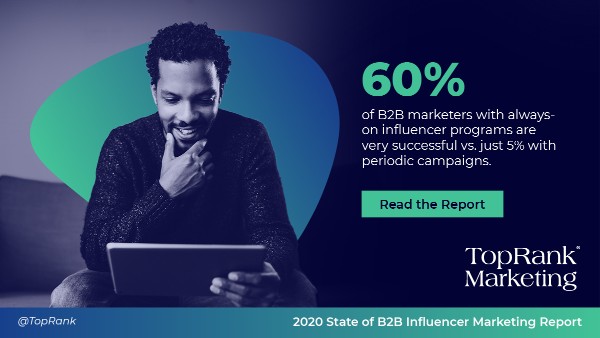
Transactional campaign approaches are hard pressed to develop brand loyalty and advocacy. That's why, with 84% of B2B marketers focused on building brand awareness with their influencer marketing efforts, that ongoing influencer engagement has become essential for creating vested relationships that inspire more qualitative activations and brand advocacy. The Engine of Influence needs to run ongoing in order to win relationships with the most trusted voices. Our findings amongst B2B marketers have found several interesting insights when it comes to an Always-On approach to influencer relations compared to campaigns, the best practices followed and what Always-On influence in action really looks like. 60% of B2B marketers who use Always-On Influencer Marketing programs are very successful vs. 5% who only use periodic campaigns.

Influencer Marketing is a Relationship Business

Distractions and competition for attention with B2B customers are at an all-time high. At the same time, B2B marketers are challenged to find the right strategies to maximize resources and marketing impact. Our research found that 76% of B2B marketers find the strategy of working with influencers through Always-On engagement or a combination of Always-On and campaigns, delivers results. In the world of business, many decisions are made based on emotion, brand strength and the trust of expert voices. B2B marketers who build relationships with trusted experts understand the value of having brand advocates engage authentically with hard to reach audiences that increasingly discount brand communications. An Always-On approach to influencer marketing provides a framework for finding, engaging and elevating relationships with those very experts that customers trust and want to hear from.

The Always-On Imperative for B2B Brands

In today’s uncertain environment, brand reach and credibility are more important than ever. Some of the top B2B brands in the world have invested in developing communities of industry experts through Always-On influencer marketing that they can count on for social engagement, event activations, and brand advocacy. Our research found that B2B marketers using an Always-On influencer marketing strategy are seeing important benefits including:
  • 75% Increased views of brand content
  • 60% Increased share of voice
  • 55% Increased media mentions of brand
  • 50% Increased brand advocacy
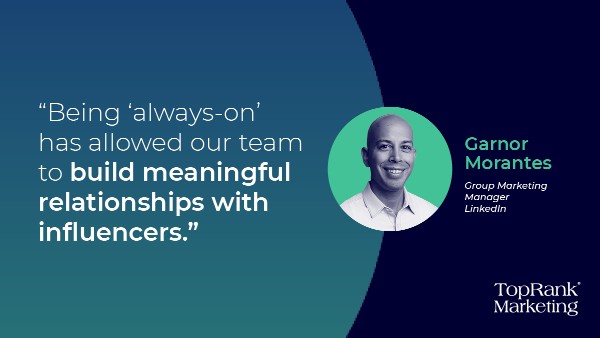
Buyers want to trust the brands they work with and with brand trust at a low, it’s important for B2B companies to invest in relationships with credible experts that buyers do trust. Garnor Morantes Always-On Influence Quote
Being "always-on" has allowed our team to build meaningful relationships with influencers. This approach means that the relationship ceases to be "transactional" (what can you do for us) when we're in a state of ongoing activity. Because of this foundation, we are in a situation where, when urgency strikes, we've been able to immediately activate influencers, whether it be for private, direct, unfiltered feedback and consult, or for external, public-facing advocacy and amplification. B2B brands would be wise to adopt an always-on influencer engagement approach as they look to build true brand advocates. Garnor Morantes, Group Marketing Manager, LinkedIn
To learn about how LinkedIn built trust and advocacy with Always-On Influence and achieving promising results including:
  • Nearly 2,000 brand mentions by influencers and their networks
  • 84M in potential reach from brand mentions by influencers
  • 200-450% above benchmark engagement on one social influencer activation
see this Always-On Influencer Marketing case study.

How Always-On Influence Drives Marketing Results

Alway-On Influencer Marketing is the practice of ongoing relationship building, engagement and activation of a specified group of influencers to build community, content and brand advocacy that is of mutual value to the brand, its customers and the influencers. From a confidence standpoint, 94% of B2B marketers using an Always-On influencer engagement strategy believe influencer marketing will grow in importance over the next 12 months vs. 73% of marketers who focus on campaigns. That confidence is reflected in marketing budgets as well. 89% of B2B marketers implementing Always-On influencer programs expect their budgets to increase or remain the same vs. 73% for marketers running campaign based programs. 28% Always-On influencer programs spend more than $100,000 per year vs. 8% for marketers running campaigns.

Always On Influencer Marketing is a strategic approach to creating communities of trusted experts that is relationship and content focused.

Those relationships are nurtured over time through ongoing engagement and activations that create value for buyers, the brand and the influencers – it is truly an “everybody wins” approach to marketing.

Then Engine of Influence is Always-On

Influencer Marketing is a relationship business and an Always-On influencer engagement strategy helps B2B brands turn those connections with trusted experts into marketing results.

60% of B2B marketers who use Always-On Influencer Marketing programs are very successful vs. 5% who only use periodic campaigns.

Always-On Influencer Marketing elevates influencer engagement from mechanical to meaningful, from transactional to relationship focused. As a result, brands like LinkedIn are able to activate their community on-demand. “When urgency strikes, we've been able to immediately activate influencers,” says Garnor Morantes of LinkedIn,”B2B brands would be wise to adopt an always-on influencer engagement approach as they look to build true brand advocates.” An Always-On Influencer Marketing strategy creates a win for everyone. With a framework that goes beyond influencer content marketing campaigns to partnering with industry experts to drive conversations and advocacy, an Always-On approach builds brand awareness, and inspires customers to trust and engage with the business. This post is an excerpt from the 2020 State of B2B Influencer Marketing Report. To learn more about the current state of B2B Influencer Marketing, including strategies, tactics, challenges, software, operations, integration and predictions for the future, access our new report here. B2B Influencer Marketing Report 2020

The post For Successful B2B Marketers The Engine of Influence is Always On #B2BIMReport appeared first on Online Marketing Blog - TopRank®.
Tuesday, August 4, 2020

6 New Rules for B2B Marketing in the COVID-19 Era

B2B Marketing Rules Covid-19

B2B Marketing Rules Covid-19 I was supposed to go to an Alanis Morissette concert this July. When the pandemic hit hard in March, I wasn’t ready to cancel my ticket yet. Surely, surely we would have it sorted in time for an outdoor concert four months from now. I held out hope. Then, in June, she rescheduled for July, 2021. And now I’m wondering if that will be enough time. Isn’t it ironic?  Don’t you think? All of which to say: This pandemic has been around for longer than we thought it would, and is looking to linger far longer than we would like. What seemed like a brief, surreal interlude to be gotten through has now become a reality to live with, at least for the time being. As B2B marketers, we need to reassess how we are adapting our marketing to our buyers’ current situation. We’re no longer scrambling to cobble together short-term fixes — we need to be out of reaction mode and into strategic planning mode. Our marketing agency has been helping clients revise their marketing plans for months now, from messaging and audience to tactics and measurement. Here are a few rules we’ve picked up that other marketers should follow:

6 New Rules for B2B Marketing in the COVID-19 Era

Rule #1: Always Be Relevant

Okay, this is less a NEW rule than a timely reminder. I’m sure most marketers who read our blog (as smart, skilled and beautiful as you are) don’t need to hear it. But just in case: You should never come to an audience without something of value. Corollary: “Something of value” can not equal “Knowledge of how our product/solution can improve your life.” People are distracted and stressed. They’re dealing with a new crisis every day. They’re spending way more time with their children than is psychologically healthy. And they have more content than ever before to occupy their free time. If you’re asking for their attention, you must reward it. Be entertaining, be useful, be both if you can. [bctt tweet="'Be entertaining, be useful, be both if you can' in your #B2B content marketing, says @nitewrites." username="toprank"] After you deliver, then you can ask for a next step. But make sure your content is intrinsically valuable.

Rule #2: Encourage Interaction

The pandemic lifestyle is, to put it lightly, isolating. Who would have thought you could miss hearing co-workers rock in their chairs, play music a little too loud, or bump into you in the hallway? Most of us are craving social interaction. If you’re used to broadcasting with your content, it’s time to consider how you can start conversations. How can you interact with your audience on a human level? How can you encourage them to interact with each other, too? Think how much your audience would value a lively, thought-provoking conversation with their colleagues and peers. You can encourage interaction with content in a few easy ways:
  • Host a LinkedIn Live chat
  • Run a Twitter chat
  • Sponsor a topic-themed chat in a video conferencing app
  • Run an interactive webinar
In general, look for ways you can call out a subset of your audience and get them talking, both to each other and to your brand representatives. We can all use a little more social interaction right now.

Rule #3: Keep Messaging Empathetic

I don’t know about you, but I cringe every time I see an ad about something “going viral.” We are 6 months into a viral pandemic and marketers are still running ads about going viral! How can this be?  This is just one example of how completely innocuous messaging pre-COVID can seem tone-deaf now. Does your content have an anecdote about a dinner party with 15 people? Does your header image feature a crowd of people? Are you talking about “going into the office” or “thinking about this on your commute?” If so, you’re alienating your audience. Not every piece of content has to be about the pandemic, or being nostalgic for the world that once was. But there needs to be a baseline of empathy: Working from home, social distancing, and mask-wearing are all facts of everyday life.

Rule #4: Experiment with Formats

In the time before the pandemic, we all spent hours looking at screens every day. It’s just there were different screens, in different environments. It was easier to differentiate between the office and home, work and play. Now, our surroundings are homogenous throughout the day — and the content we consume feels same-y, too. Think about content fatigue as you plan your calendar. Is your audience looking for another wall of text? Do they want to look at another grid of talking heads?  Our agency is finding more success right now with multimedia, interactive content. Our B2B Influencer Marketing report is an example. The content includes case studies, influencer participation, and original research, presented in an animated, dynamic way. Essentially, keep in mind that idea of efficiently delivering value. Can your blog post be a quick video or audio interview instead? And can that video be five minutes long instead of 10?  [bctt tweet="Can your blog post be a quick video or audio interview instead? And can that video be five minutes long instead of 10? says @nitewrites." username="toprank"]

Rule #5: Collaborate on Content

For me, one of the stranger elements of pandemic life is learning how similar I am to everyone else. I had an urge to do puzzles in March — all the stores were sold out. I wanted to make bread in April — the stores ran out of flour. In May, everyone bought bikes.  Right now, every B2B business is missing their trade shows and in-person demos. So most of them are doubling down on content. The best way to differentiate your content is to bring your audience voices they can’t hear anywhere else. Co-create content with influencers. Feature subject matter experts in your organization. Tap your current and prospective customers to get their take. The more voices you can bring to your content, the more it will stand out to your audience.

Rule #6: Re-Align Measurement with Current Goals

Per rule #1, people are less interested in promotional content right now. Businesses may have put their purchasing plans on hold, or at least tightened budgets. Marketing’s chief goal right now is likely to be establishing brand credibility, creating thought leadership content, and building relationships for the future. As your goals change, your measurement must change as well. You can’t measure an awareness campaign in SQLs, or relationship-building in number of demo requests received. That doesn’t mean giving up on measurement or accountability — it just means making the metrics match your goals. For example, you could measure:
  • Brand share of voice
  • Email/Blog subscribers
  • Social media audience/interactions
  • Content consumption metrics (time on page, scroll depth, links clicked)
  • Content resonance (backlinks and social shares)

How New Are These Rules?

So here’s the $100,000 (adjusted for inflation) question: At what point should you stop producing relevant, interactive, empathetic, dynamic and collaborative content? When can you heave a sigh of relief, stop listening to your audience, and start broadcasting promotional messages? When you put it that way, it’s obvious: These rules are best practices for content no matter what’s going on in the world. The pandemic didn’t create the need for these rules; it just amplified how crucial they are. Back in January, we might have had the luxury of ignoring one or more of them. Now we have the joyous necessity of being forced to do better. And that’s the good news: Making your marketing better for the pandemic will make you a better marketer now and for whatever comes next. Need help creating content? We’re here for you.

The post 6 New Rules for B2B Marketing in the COVID-19 Era appeared first on Online Marketing Blog - TopRank®.
Monday, August 3, 2020

20 B2B Influencer Marketing Pros to Follow from Top Brands

B2B influencer marketing pros from top brands

B2B influencer marketing pros from top brands Recently we published the 2020 State of B2B Influencer Marketing report after surveying hundreds of B2B marketers about their experiences, best practices, tools, budgets and plans for the future. In an environment where B2B marketing is decidedly digital and marketers are hard pressed to squeeze more productivity out of fewer resources, credible information about marketing best practices, operations and trends for the future are in high demand. Judging by the response we've had to The State of B2B Influencer Marketing Report so far, we're definitely meeting a need. There is both optimism and an unrealized opportunity with influencer marketing for B2B companies. For evidence, check out these stats from the report:
  • 78% of B2B marketers believe prospects rely on advice from influencers
  • 74% believe that Influencer Marketing improves customer and prospect experiences
  • 63% agree that marketing would have better results if it included an Influencer Marketing program
  • 60% of marketers who use always on Influencer Marketing programs are very successful vs. 5% who do periodic campaigns
And yet:
  • Only 19% of B2B marketers are running ongoing influencer marketing programs
  • Only half include a plan for influencer activation in their influencer marketing strategy
  • Only 35% of marketers use software to identify potential influencers
  • 60% say they don’t have the knowledge to execute or have the right skills in house to implement ongoing Influencer Marketing programs
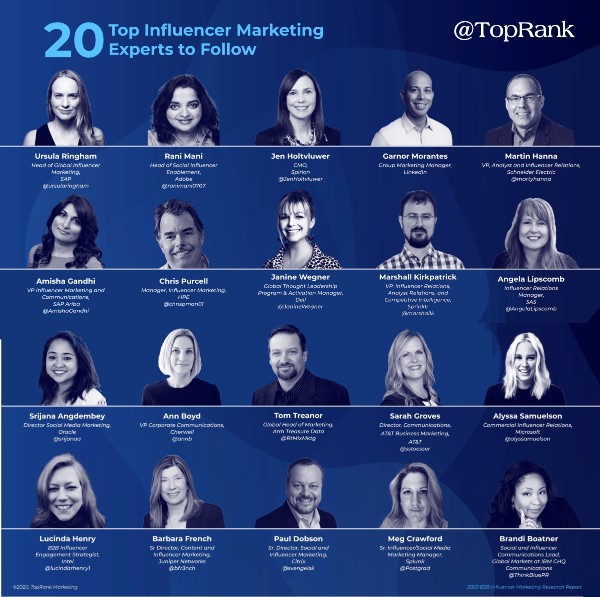
Influencer Marketing is a significant opportunity for B2B Marketers to connect with trusted and credible experts that have the attention of audiences that are probably overwhelmed with information and ignoring most of the ads that do get to them. At the same time B2B brands that build relationships to co-create content with these industry voices can integrate influence with thought leadership to build the authority and influence of brand employees. It is very satisfying to have spent the past 8 years focusing on such a niche aspect of B2B marketing to see it now start to grow in acceptance, adoption and maturity amongst some of the top B2B brands in the world.  Where there were previously no positions outside of PR with "influencer" in the title, now it is much more common to find marketers with titles like, Head of Global Influencer Marketing, VP Influencer Marketing and Communications, or B2B Influencer Engagement Strategist. Many B2B marketing professionals with these titles have earned hard won insights into what makes influencer marketing truly work for B2B, especially during a time when brand marketers are highly motivated to focus on strategies and tactics that will help them survive and thrive during the pandemic. To help you connect with the collective wisdom of the B2B influencer marketing crowd, here are 20 B2B Influencer Marketing Professionals to follow (in no particular order): Ursula Ringham Ursula Ringham @ursularingham Head of Global Influencer Marketing at SAP Rani Mani Rani Mani @ranimani0707 Head of Social Influencer Enablement at Adobe Jen Holtvluwer Jen Holtvluwer @JenHoltvluwer CMO at Spirion Garnor Morantes Garnor Morantes /in/garnormorantes/ Group Marketing Manager at LinkedIn Martin Hanna Martin Hanna @martyhanna VP, Analyst and Influencer Relations at Schneider Electric Amisha Gandhi Amisha Gandhi @AmishaGandhi VP Influencer Marketing and Communications at SAP Ariba Chris Purcell Chris Purcell @chrispman01 Manager, Influencer Marketing at Hewlett Packard Enterprise Janine Wegner Janine Wegner @JanineWegner Global Thought Leadership Program & Activation Manager at Dell Marshall Kirkpatrick Marshall Kirkpatrick @marshallk VP, Influencer Relations, Analyst Relations, and Competitive Intelligence at Sprinklr Angela Lipscomb Angela Lipscomb @AngelaLipscomb Influencer Relations Manager at SAS Srijana Angdembey Srijana Angdembey @srijanaa Director Social Media Marketing at Oracle Ann Boyd Ann Boyd @annb VP Corporate Communications at Cherwell Software Tom Treanor Tom Treanor @RtMixMktg Global Head of Marketing at Arm Treasure Data Sarah Groves Sarah Groves @sstoesser Director, Communications, AT&T Business Marketing at AT&T Business Alyssa Samuelson Alyssa Samuelson @alyssamuelson Commercial Influencer Relations at Microsoft Lucinda Henry Lucinda Henry @lucindarhenry1 B2B Influencer Engagement Strategist at Intel Barbara French Barbara French @bfr3nch Sr Director, Content and Influencer Marketing at Juniper Networks Paul Dobson Paul Dobson @svengelsk Sr. Director, Social and Influencer Marketing at Citrix Meg Crawford Meg Crawford @Postgrad Sr. Influencer/Social Media Marketing Manager at Splunk Brandi Boatner Brandi Boatner @ThinkBluePR Social and Influencer Communications Lead Global Markets at IBM Of course there are many B2B influencer marketing practitioners from the consulting and agency world that could be on a list like this, including some of my team at TopRank Marketing. Maybe we'll publish such a list in the future, but for now this resource is focused on people working at B2B brands. If you know of other B2B brand influencer marketing practitioners, who would you add to this list? To tap into the collective wisdom of these and more B2B influencer marketing experts, be sure to check out the full report here. B2B Influencer Marketing Report 2020 *SAP, LinkedIn, SAP Ariba, Dell, Cherwell and Treasure Data are TopRank Marketing clients. 


The post 20 B2B Influencer Marketing Pros to Follow from Top Brands appeared first on Online Marketing Blog - TopRank®.