Tuesday, November 19, 2019

Break Free B2B Series: Hal Werner on the Intersection of Marketing Creativity and Analytics

Break Free B2B Interview with Hal Werner of Mitel

Break Free B2B Interview with Hal Werner of Mitel Part art, part science, all business. This is the credo under which Hal Werner operates. As Global Manager of Digital Marketing & Strategy for Mitel, he’s responsible for overseeing the telecommunication company’s marketing programs from a holistic view, and understanding how all the pieces fit together. Coming from a background in copywriting and content strategy, while also possessing considerable experience with SEO, PPC, and analytics tools, Hal believes the key to unlocking success in this modern era of digital marketing resides at the intersection of creativity and data. “You find that companies are really good at one or the other,” he explains of the art and science of marketing. “And that gives you good, but when I see great, it's almost always when the two are together. So you have a really good insight that's maybe based on data, you have a data-led execution, and you have a creative execution of that idea. That really makes it shine because without either those parts it, can fall flat.”  [bctt tweet="You find companies that are really good at the art or science of marketing. That gives you good, but when I see great, it’s almost always when the two are together. @halwerner #MarketingStrategy #BreakFreeB2B" username="toprank"] In our wide-ranging interview with him for the Break Free B2B series, Hal shared his thoughts on sophisticating attribution, merging content strategy with SEO, and creating operational structure to get the most out of your people, roles, and positions. 

Break Free B2B Marketing Interview with Hal Werner

For a sampling of what’s inside, you can check out a few highlights from our chat below. Nick: One thing we talk about here at TopRank is purpose — whether that's your company having a purpose beyond its business function, or even down to the granular level of every piece of content you create. It's very easy to get caught in this pattern of just churning things out. So it's really good to take a step back, right? And just review and say, well, what is what is the purpose of this single thing we're creating? Hal: Yeah. If you want to create a piece of content about a topic, but you can't create the best one, why are you creating it? Someone's already covered that. I think it's the same way with function in a company, right? If you don't truly believe that you can outdo your competitors in the space for that function, then what are you wasting your time on? [bctt tweet="If you want to create a piece of content about a topic, but you can't create the best one, why are you creating it? Someone's already covered that. @halwerner #ContentStrategy #B2Bmarketing #BreakFreeB2B" username="toprank"] Nick: Given your background in search engine marketing, I'm really curious to get your thoughts on the intersection between content strategy and SEO. I really see them becoming sort of the same thing. Are you seeing that trend play out? Hal: I think the most successful companies are doing that and the tough thing is, it's hard to operationalize. It's easy if you have a person who understands all of those things and how they work together, and they can either do it or direct it — then you're in a good position. But if you just have a team of disparate people, it gets much harder. So I always like to start every project with an insight. If there's not a core insight at the beginning of a project, then I tend to not actually pursue it because I think it's kind of empty. I think those insights can come from a lot of places, and they have to funnel into content and SEO. Sometimes the insight might be a keyword, you might see something on Google Trends blowing up that you can get on top of, or it might come from the sales team, right? The boots on the ground, ‘Hey, guys, we're always hearing people asking about this.’ And you can feed it in that way. You might find out one topic, go plug it into a tool and find out there's a lot of other questions people are asking to really enrich what you're going to create. Nick: Tactically speaking, what do you see as some opportunities to push back against the trend of diminishing organic reach and really firm up your brand? Hal: I think there's a couple things you can do. For one, we might actually see a little bit of reinvestment into some of the traditional branding channels and advertising channels to do that. I also think there may be some shift from a lot of digital channels that have a strong demand generation or e-commerce focus. I think a lot of those channels you might see more usage for branding. Display is an area where some industries are already doing that. Other industries may follow a little more. But I also think one of the interesting things, one of the things you guys do, is influencer marketing. If your channels aren’t getting that reach, then these people in these other channels might be able to help your brand get out there, right? So whether whether you earn it or whether it's paid for, you're going to need more voices putting out there what you're about so that not only people see you, but you begin to be associated with that thing at a critical mass. Stay tuned to the TopRank Marketing Blog and subscribe to our YouTube channel for more Break Free B2B interviews. Here are a few interviews to whet your appetite:

The post Break Free B2B Series: Hal Werner on the Intersection of Marketing Creativity and Analytics appeared first on Online Marketing Blog - TopRank®.

Monday, November 18, 2019

Why California’s New Data Privacy Law Matters to Marketers Everywhere

There’s No Time Like the Present to Lock Down Your Data Privacy Practices

There’s No Time Like the Present to Lock Down Your Data Privacy Practices Be compliant or be complacent. These are the two options facing brands and marketers today, as data privacy laws continue to increasingly take hold. For those paying attention, it’s been clear for some time that Europe’s GDPR regulations were only the beginning of a global effort to formalize and enforce protections for internet users and their personal data. But with California’s landmark privacy legislation, CCPA, set to become enforced in 2020, data privacy is no longer a distant foreign concern for American businesses, if it ever was. [bctt tweet="Be compliant or be complacent. These are the two options facing brands and marketers today, as data privacy laws continue to increasingly take hold. @NickNelsonMN #dataprivacy #digitalmarketing" username="toprank"]

What is the CCPA?

At a high level, the purpose of the California Consumer Privacy Act (CCPA) is quite similar to that of GDPR: It’s about giving people transparency into, and control over, how their personal data is used by companies.  As the epicenter of technological advancement in the United States, California is a logical launch point for this type of legislation. The bill was signed into law by Gov. Jerry Brown in summer of 2018, and after a period of back-and-forth amending, it’s slated to officially go into effect on Jan. 1, 2020. To cut through the complexities and narrow it down, the CCPA includes three primary mandates. Starting next year, residents of California must be able to:
  • Access their personal information (what’s been collected, by which companies, and why)
  • Request deletion of personal information (via, at minimum, a toll-free phone number)
  • Opt-out from having their personal information sold (via link on home page of company website)
Now, it bears noting that there’s a fair amount of specificity in the CCPA. For example, the companies that fall under its scope must satisfy certain thresholds in terms of annual revenues, amount of data possessed, and percentage of revenue derived from the sale of consumers’ personal information.  The new law is also ostensibly localized in one state, although that’s a bit misleading: Any company doing business in California is subject to CCPA’s guidelines. The International Association of Privacy Professionals estimates more than half a billion U.S. companies will be affected. via GIPHY Plus, as Len Shneyder writes at Marketing Land, the Golden State is hardly alone in pushing for data privacy laws: “Bills in New York and other states are making their way through legislatures, all with similar yet nuanced provisions, protections and, in many cases, breach notification requirements.”

Be Compliant, Not Complacent

Whether through the proliferation of state-level laws like CCPA, or the eventual enactment of a similar federal legislation, it’s only a matter of time before data privacy regulations are in place across the United States. For marketers and brands doing business in California, compliance is no longer optional. And I’d suggest the same is true for all others, because the alternative – complacency – is only going to set you back while putting customer relationships at risk. We’ll have to wait and see what kind of specific penalties are levied for those who violate CCPA, but companies running afoul of GDPR regulations have already felt the sting — Google was fined $50 million earlier this year for failing to disclose how data is collected across its various services and platforms. British Airways and Marriott are also among the companies to receive fines under the new law Incurring financial penalties shouldn’t be the only motivation here, though, and maybe not even the primary one. As I wrote here earlier this year, when addressing the growing trend toward data privacy legislation, “brands everywhere should take a hard look at their own customer data practices, not just because of these looming legal implications but even more so because it’s plain-old good business.”  We’re all wise to aim for the kind of transparency and control mandated by the CCPA. Responsible data handling is essential to building trust in this evolving digital world. Microsoft is among those leading the charge on this front, pledging to “honor California’s new privacy rights throughout the United States.” 

How to Get Compliant with Data Privacy Practices

By no means would I advise that marketers stop collecting and leveraging user data. This information is often necessary to form accurate customer insights as a basis for resonant marketing programs. But we do need to ensure we’re being very up-front about the what, why, and how. Complacency just ain’t a good look. [bctt tweet="By no means would I advise that marketers stop collecting and leveraging user data... But we do need to ensure we’re being very up-front about the what, why, and how. @NickNelsonMN #dataprivacy #digitalmarketing" username="toprank"] As a starting point, here are some general advisable practices when it comes to transparent data privacy:
  • Ensure you’re making very clear — on your website and any other applicable digital properties — what information you’re capturing from visitors and how you’re going to use it. This is crucial.
  • Collect only the data you need, and nothing more.  
  • Make it extremely easy for your audience to opt out of everything. Consent is king (that’s how the saying goes, right?).
  • Implement multi-layered security measures wherever customer data is stored — especially in cloud-based services.
  • Make data privacy a central and persistent talking point in your organization. Everyone involved should be part of the conversation.
Meanwhile, getting specifically compliant with CCPA and its core principles will put virtually any business in a good position going forward. To that end, here are some helpful resources: You’re also welcome to reach out to our team at TopRank Marketing if your organization is looking for a partner that understands the data privacy landscape. We’ve been working with several clients under GDPR guidelines since its inception, so we’re no strangers to its scope and implications.

The post Why California’s New Data Privacy Law Matters to Marketers Everywhere appeared first on Online Marketing Blog - TopRank®.

Thursday, November 14, 2019

Break Free B2B Series: Clare Carr on Using Data to Drive Content Marketing Success

TopRank Marketing Interviews Clare Carr, VP of Marketing at Chief

TopRank Marketing Interviews Clare Carr, VP of Marketing at Chief Intertwined from the start. For marketing executive Clare Carr, digital marketing and data have been a packaged deal since the beginning of her career. But for most marketers, while data is plentiful, leveraging that data (and diriving actionable insights to improve content strategy) is an evolving challenge. Most of us are just beginning to scratch the surface of our data's potential. But according to Clare, who spent more than six years at content analytics platform Parse.ly, data can do more than help us optimize performance "after the fact." Data can help us build our brand. Data can help us become better storytellers. Data can help us grab attention. [bctt tweet="If you're not providing actual value to someone, they tune you out. @clareondrey #B2BContentMarketing #BreakFreeB2B" username="toprank"] As part of our Break Free B2B interview series, TopRank Marketing Senior Content Marketing Manager Joshua Nite sat down with Clare to talk data-driven B2B content marketing, storytelling, and so much more. At the time of the interview, Clare was still part of the Parse.ly family, but has since struck out on her own. She's now the Vice President of Marketing for Chief, which is a network and community for powerful women in the industry. Through the interview, you'll see that Clare believes marketers should focus on how their companies, campaigns, people, and stories can work together to drive success. Further, she counsels us to be implicitly aware of what is worthy of your customers' attention. Click the play button on the video below to dive into the full interview.

Break Free B2B Marketing Interview with Clare Carr

  Haven't pressed play just yet? Here are a couple of our favorited excerpts from our time with Clare. Josh: It is amazing how the field of SEO has gone from very prescriptive to very data-driven. We have to determine what the demand is, we can't just shove it down people's throats. Do you feel like that? Clare: Absolutely, and people will tune out content that isn't valuable to them. That's, I think, one of the biggest changes over the past 10 years. You used to be able to sort of trick algorithms. But Google has gotten smarter and audiences have more choices than ever before. If you don't capture their attention with valuable information, it goes somewhere else. Data is kind of becoming in a way that we can get at what these people want, especially what kind of information they want. When it started, we thought a data-driven marketer would be someone who was able to track everything correctly, be able to give their conversion path, and figure out the KPIs and metrics they need to measure. But now, we're talking about applying data to content. I think the biggest takeaway that people are surprised by is the data can be really closely associated with your brand. It can be something that makes you unique and memorable. It's something that is hard for other people to replicate. [bctt tweet="Data can be really closely associated with your brand. It can be something that makes you unique and memorable. @clareondrey #DataDrivenMarketing #B2BContentMarketing #BreakFreeB2B" username="toprank"] So, if you can make data something that people associate with you, they trust you more, you can connect with them more, and you can tell better stories. All those things you want as a content marketer, as a B2B marketer, data can actually do for you. It's not just good writing, good storytelling, and good creative anymore. Josh: Are you talking only about the first party research that brands might do? Or is there another way to associate that value of the data with the brand? Clare: First-party research is certainly one way to do it. I think internal data, in general, is something that more brands should look at and see what they have available to them, and then how they can use that for content. For instance, [Parse.ly is an] analytics company and we have individual clients' dashboards, but we can see trends across 10 billion monthly interactions with content. One of the things that we get asked about a lot is, "Are more people reading content coming from Facebook? Are they coming from Google?" That's all information that is basically runoff data for us. It's data that we have, we're not using it in our product. So we can write a lot about it, we can share it with people, we can help them understand how they fit into the broader trends of the industry, and whether they're on track or if there are things they need to change in their strategy. It becomes a content source, it becomes client engagement, it becomes industry and formation. Josh: How do you get that data to the content folks in a way that it makes sense to them, and they can use it? Clare: That is the big challenge. I think a lot of people underestimate how important it is to combine those worlds. [bctt tweet="A lot of people underestimate how important it is to combine the data team and content team's worlds within an organization. @clareondrey #DataDrivenMarketing #B2BContentMarketing #BreakFreeB2B" username="toprank"] I've seen that some of it is just repetition—bringing data to them that they understand. We have a lot of clients that use Parse.ly for that purpose. They bring their reports, that are really easy to understand and have a lot of data, to their data team and say, "Hey, you know, we're doing some really great stuff with this too. Here's the data to prove it. How can we work together?" Then, their PPC team or their SEO team says, "Hey, wait a second, this content is really performing. We're going to start building that into our programs as well." We've seen some companies have a lot of success with that, but it's it takes a human element that cannot be taken out of this equation. Maybe sometimes buy people beers or pizza or maybe a gluten-free option, you know, depending on what everyone wants. Convince them that both sides of these coins are very important. Ultimately, if you want the success of your company, you're going to need them both to work. Stay tuned to the TopRank Marketing Blog and subscribe to our YouTube channel for more Break Free B2B interviews. Here are a couple interviews to whet your appetite:

The post Break Free B2B Series: Clare Carr on Using Data to Drive Content Marketing Success appeared first on Online Marketing Blog - TopRank®.

Wednesday, November 13, 2019

5 B2B Brands Innovating with AR & AI Marketing

Successful corporate team of partners and coworkers.

Successful corporate team of partners and coworkers. Augmented reality and artificial intelligence aren’t just for B2C marketers anymore, and as we move into 2020 we’re likely to see a new decade of B2B that keeps moving farther away from “Boring-To-Boring” and towards more to B2C-like experiences. AR and AI are a key part of what consumers increasingly expect to find in those experiences. The swiftly rising number of mixed-reality consumer app installations is expected to jump from 3 billion to 10 billion by 2024, with associated ad spending forecast to climb from $2 billion in 2019 to $11 billion, according to new Juniper Research data. While AR and AI in consumer-facing efforts keeps expanding with a full head of steam, such as Warner Bros. first-ever embedded AR for its upcoming “Scoob!” film trailer and mobile app, many in the B2B landscape have scarcely begun to tap into the AI-infused technology available. Let’s take a look at five B2B brands that are innovating with a variety of AR and AI marketing initiatives.

1 - Microsoft's Reddit-Powered Chatbot Tech

Microsoft DialoGPT Microsoft recently announced a natural language enhancement program that will add a new level of human-like responsiveness to chatbots, with its DialoGPT initiative that taps into an archive of nearly 150 million conversations from social news aggregation and discussion website Reddit. The project seeks to lend a more conversational and human tone to the AI that powers chatbots, and by incorporating Reddit’s unique blend of tech-savvy online scenesters and cut-to-the-chase real-world solutions, the next generation of chatbots that arise from Microsoft’s DialoGPT endeavor are likely to be a noticeable change from those we use today. Microsoft took efforts to clean its Reddit archive to include only relevant and helpful conversation history, but has issued a warning that despite its best efforts some of the chatbot responses could still contain the type of content that may not yet be ready for typical B2B environments. Although the project is still in testing, Microsoft has made it available to AI researchers looking to take their chatbot game to the next level, and not surprisingly Reddit users have also turned their attention on the new development.

2 - Hubspot’s HubBot Chatbot

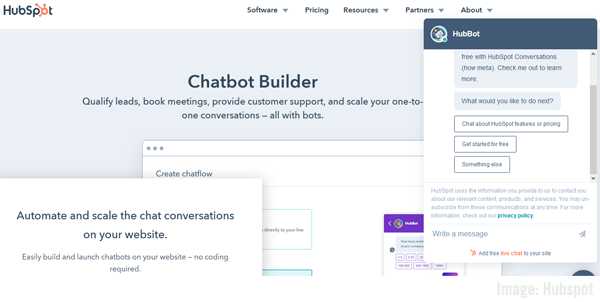
Hubspot Chatbot technology’s usage has grown steadily since its introduction just a few years back, and more B2B firms are making chatbots a prominent component of their business models. Hubspot website visitors are welcomed by its HubBot chatbot, which serves as an automated gatekeeper to put the company’s existing or potential clients in touch with the most relevant human to answer any questions it isn’t able to answer. Hubspot also provides personalized chatbots with its HubSpot Conversations, and a variety of other AI-powered tools, so it makes sense for the firm to showcase a powerful chatbot for its own site.

3 - Drift & Sigstr’s Conversational Email Chat

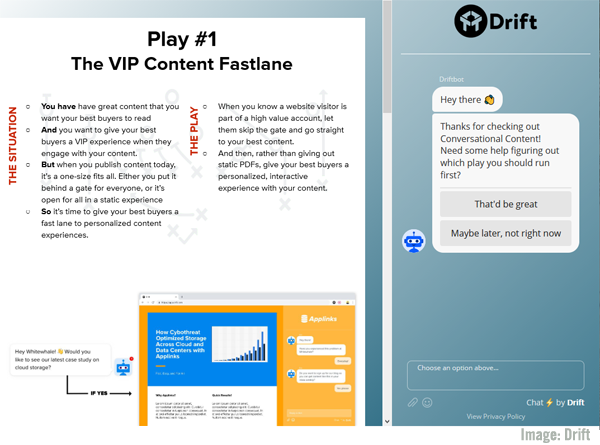
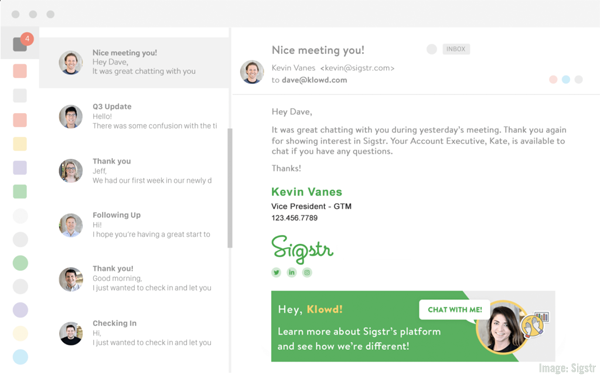
Drift Account Based Marketing (ABM) software company Drift and email marketing platform Sigstr recently joined together on a new service that joins together email signatures and real-time conversations with either chatbots or real people. Sigstr We’ve written about Drift before, most recently during the #B2BSMX conference, where company vice president of marketing Dave Gerhardt shared a variety of helpful conversational B2B marketing tactics. Sigstr has also made our previous list of “5 Examples of Remarkable Content Marketing in Action,” and now with its Drift partnership the combined firms are leading the way by merging the decidedly-classic tech of email with modern chatbot functionality in an ABM environment particularly well-suite for B2B marketing efforts.

4 - Adobe's Aero & #ProjectPronto

Adobe Terminator Adobe* recently demonstrated the latest work on its Aero products, aimed at making it easier to create augmented reality campaign content for mobile devices, using the launch of the “Terminator: Dark Fate” film as the theme for its Terminator Max Experience, a showcase for how B2B and B2C firms will be able to use the product to produce impressive AR experiences. Adobe’s Terminator Max Experience demonstration also let participants work with the technology on an actual set using cues to act out their own scene. Below is a video from one of several sneak-peaks Adobe shared at its recent Adobe MAX 2019 developer conference, showing some of the eye-opening AR possibilities that the technology will enable for B2B firms. Adobe also shared more information about its #ProjectPronto initiative, which uses AI to build real-time AR scenery within video.

5 - Cisco’s AR & VR Interactive Catalogs

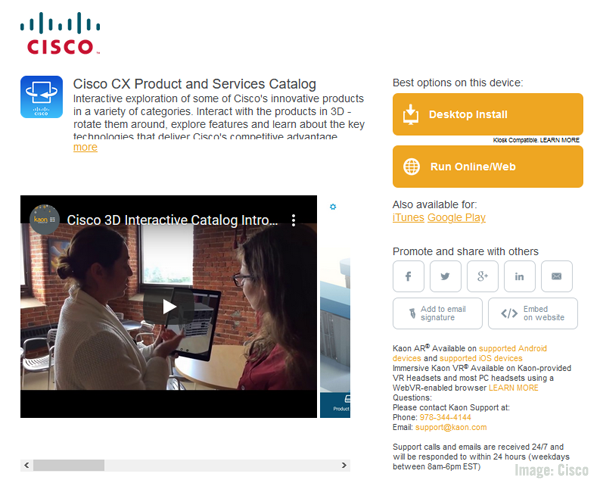
Cisco Cisco has used both AR and virtual reality in its latest generation of online interactive product catalogs, allowing existing and potential clients to get a fresh take on the firm’s massive slate of technology offerings. Cisco has brought what has traditionally been considered typical “Boring-To-Boring” content to new life by using vibrant and immersive AR and VR, a great example of how even catalog content can breathe fresh air into a B2B firm’s marketing and customer experience efforts. With both a desktop version from B2B software firm Kaon Interactive and a variety of app versions available through Google Play, iTunes and others, Cisco has done an admirable job in making its interactive AR catalogs readily available. Cisco Software

Moving Ahead with New Tech for 2020

The campaigns we’ve explored here from Microsoft, HP, Drift, Sigstr, Adobe, and Cisco are examples of the type of AR and AI innovation that may become increasingly widespread as we move into 2020 and a new decade of B2B that keeps moving farther away from “Boring-To-Boring” and to more to B2C-like experiences. In closing, here are five of our most recent articles exploring some of the other areas where B2B marketing will change in the months and years ahead. * Adobe is a TopRank Marketing client.

The post 5 B2B Brands Innovating with AR & AI Marketing appeared first on Online Marketing Blog - TopRank®.

Tuesday, November 12, 2019

Break Free B2B Series: Brody Dorland on Creating Long-Lasting Content Marketing Strategy

An Interview with Brody Dorland of DivvyHQ

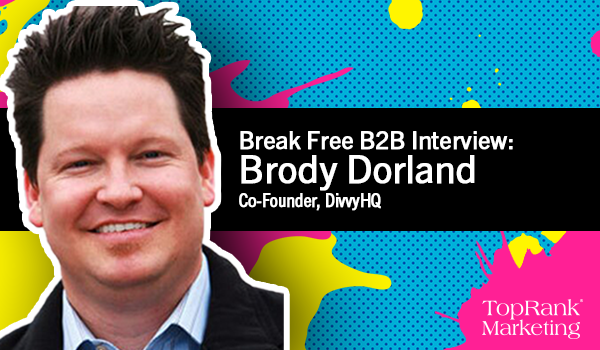
An Interview with Brody Dorland of DivvyHQ We're ready to release another insightful interview as a part of our Break Free B2B series, this time with Brody Dorland, co-founder of the popular content planning platform, Divvy HQ. Brody is a self-described data geek. He believes data is a crucial component of successful content marketing. The platform that he co-created is all about bringing data, structure, and strategy into content marketing. We feel that he's a practitioner who is uniting that data side with the creative side within B2B content marketing. That's why we were so excited to sit down with him for a few minutes and pick his brain. We not only spoke about what B2B content marketers can start doing to boost the success of their content marketing initiatives, but also gain insight into where B2B content marketing is headed in the future. See the full interview below so that you don't miss a single insight from our friend, Brody Dorland. Here are a few of our favorite moments from the interview with Brody. Sue: So you've been in the content marketing industry for quite some time. Over the years, what have you seen as the biggest improvements? Brody: I've really been pleasantly surprised to see the evolution of just how smart companies are getting with their strategy. Actually, this morning [at CMW 2019], they talked about the latest data from Content Marketing Institute's, saying that 41% of marketers now have a content strategy in place, which is up from last year, which I think was 34%. So we're making progress. Part of the onboarding process that we go through with companies is to bake in their content strategy into our tool so that we can help them manage it going forward. The thing that we've seen from an evolution standpoint is that it's getting easier for them to get that content strategy baked in. When we ask them questions, like, "Okay, what are the topics of content that you typically cover?", they're able to plug that in easier. When we asked, "What audiences are you targeting with your content?", they're able to plug that list in easier because they've thought about it. They have a documented content strategy in place, so it's easier to plug into that area of our application and we can get them set up faster. Sue: Let's talk about something less positive. What's not working in the industry? Brody: I think one of the things that we still see and we preach every day, but we still see it, is the campaign mentality. There's still a large focus on very business-focused campaigns and obviously, they need content. So, a lot of times, the same content team that is doing all of the content efforts are also going to be responsible for creating assets for this campaign. But there's a mindset shift that needs to happen to get away from just "campaign, campaign, campaign" and filling our channels with these time-bound things. [bctt tweet="There's a mindset shift that needs to happen to get away from just 'campaign, campaign, campaign' and filling our channels with these time-bound things. @brodydorland #B2BContentMarketing" username="toprank"] Certainly, if there's a good content team, they should produce results. But it's never going to be the long-sustained content, the true content marketing play, that needs to happen within many organizations. Obviously, different channels are going to lend themselves to that—like a blog. It's never-ending; we always need to have a solid content strategy for that. We always need to be optimizing for Google with that blog content. It's not a campaign. So a completely different mindset in terms of how we tackle that channel versus email, which tends to be more campaign-centric. I feel strongly that companies really need to try to continue to get out of the campaign mentality and just leverage their channels for ongoing, good content that's going to serve their audience. [bctt tweet="I feel strongly that companies need to get out of the campaign mentality and leverage their channels for ongoing, good content that's going to serve their audience. @brodydorland #B2BContentMarketing" username="toprank"] Sue: What do you think are the drivers for that? Why has that happened? Brody: I think it just comes out of the traditional marketing world. However, the holistic content marketing world, which is non-campaign focused, continues to proliferate. It's going to get better, but most agencies out there that still so campaign focused—that's what they've been doing for decades. Getting out of that mindset, even from a logistics standpoint, is harder for an agency to do. Not to say that agencies can't continually be involved in longer-term content marketing engagements, but it's just it's a different beast, a different animal than the typical world that they've been in for decades. Stay tuned to the TopRank Marketing Blog and subscribe to our YouTube channel for more Break Free B2B interviews. Here are a couple interviews to whet your appetite:

The post Break Free B2B Series: Brody Dorland on Creating Long-Lasting Content Marketing Strategy appeared first on Online Marketing Blog - TopRank®.

Monday, November 11, 2019

5 Key ABM Trends for B2B Marketers to Track Heading into 2020

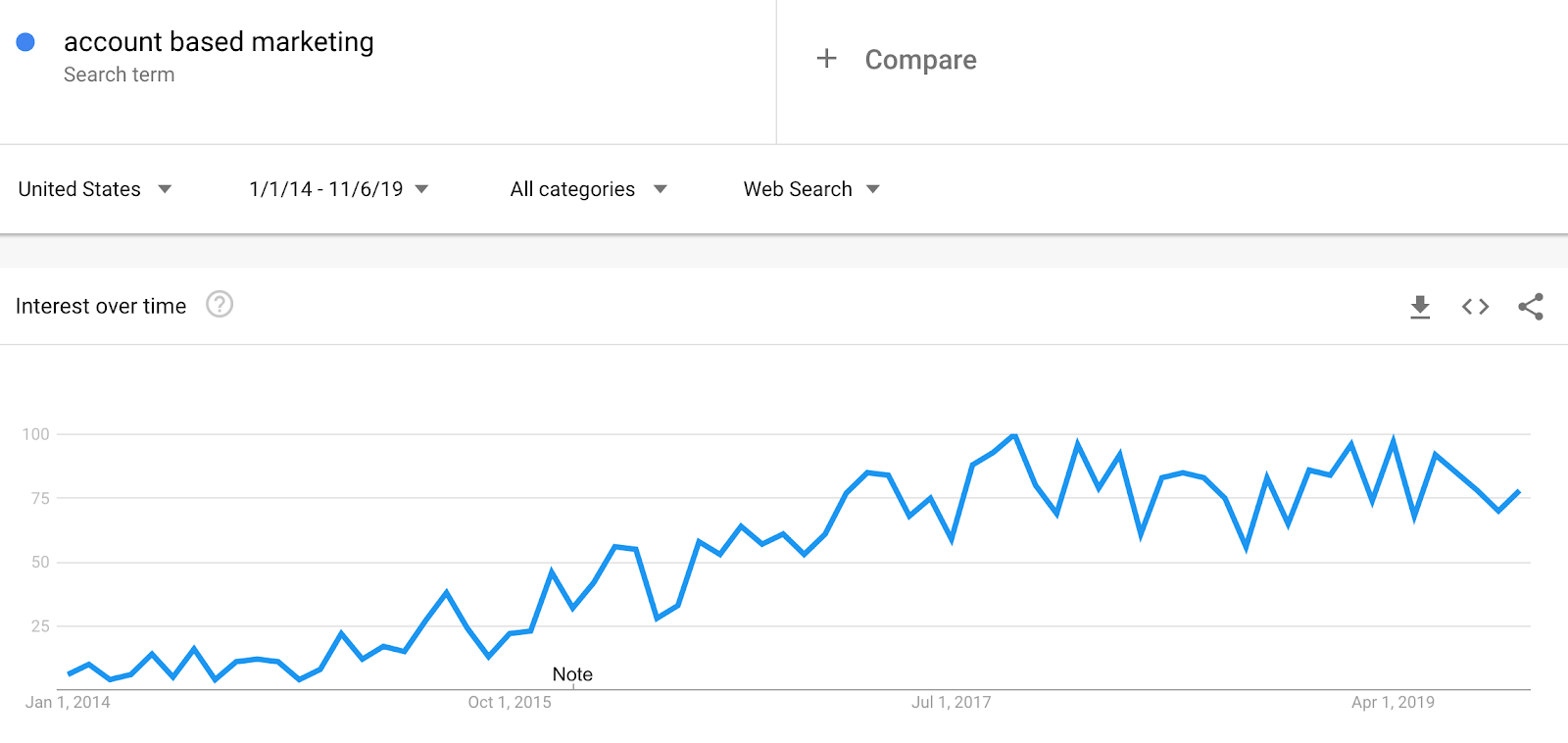
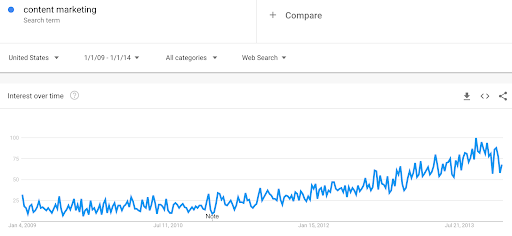
I’ve attended two B2B conferences in the past few months – B2B Sales and Marketing Exchange in Boston, and MarketingProfs B2B Forum in Washington DC – and at both, account-based marketing was unmistakably top-of-mind. A majority of sessions and conversations evoked the term in some fashion, matching the trend I’ve noticed online and in client interactions. A look at the Google Trends trajectory for “account based marketing” over the past five years reminds me a bit of the trajectory for “content marketing” in the five years prior. Account-Based Marketing Google Trends Data Content Marketing Google Trends Data It’s only natural that B2B organizations everywhere are either adopting or taking an interest in ABM, because the strategy is founded on so many key pillars of effective marketing today: personalization, organizational alignment, and the focused pursuit of high-value customers. Understanding the state of ABM and where it’s heading is critical for any B2B marketing practitioner today. Based on what I’ve been picking up at these events, along with data shared in the newly released 2019 ABM Benchmark Survey Report from Demand Gen Report, here are five trends to focus on as we move into 2020.

5 Key ABM Trends to Plan Around in 2020

The fourth annual ABM benchmark study from Demand Gen Report, which surveyed more than 100 B2B business executives from various industries, ranging across several roles, serves to confirm and reinforce a number of trends we’re seeing in the world of account-based marketing.

1. ABM is B2B Marketing

Only 6% of respondents in the survey said they are not doing ABM yet in any form. Meanwhile, 50% said they’ve had their ABM initiatives in place for more than a year, while another 25% gotten started within the past six to 12 months.  When we covered Demand Gen Report’s 2016 survey on ABM benchmarks, only 47% of respondents said they had an ABM strategy, so clearly the practice has grown substantially in a span of three years. For me, this growth not only signals that B2B brands are increasingly conscious of creating content and experiences for specific buying audiences, but that those efforts are aimed beyond a singular buyer. After all, one of the major premises of ABM is acknowledging that different people with different viewpoints make up a buying committee, something that every B2B marketer needs to pay attention to on the go-forward.

2. Sales and Marketing Alignment is the Biggest ABM Challenge

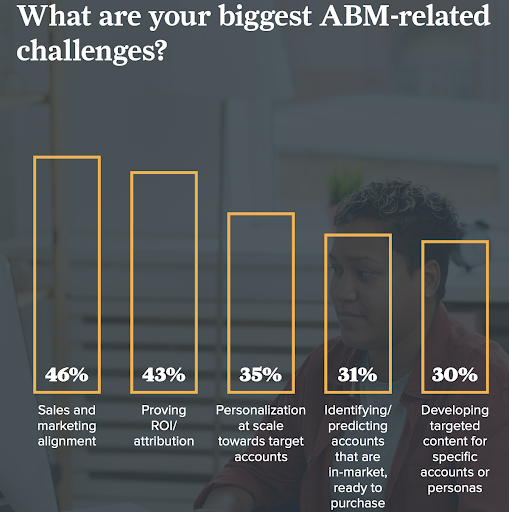
Most companies report being in the earlier stages of ABM maturity, and it’s evident that sales and marketing alignment is a common barrier to progress, with a leading 46% of survey respondents citing it as their biggest ABM-related challenge.  Top ABM Challenge Data (Source: 2019 ABM Benchmark Survey Report) This struggle isn’t unique to account-based marketing, of course, but ABM is uniquely positioned to help solve it. A strategic and sophisticated ABM program is built on orchestrated account selection, outreach, and nurturing processes. These strategies also tend to measure success based on overall results rather than getting bogged down in credit attribution, helping reduce friction and internal contention. Better alignment between sales and marketing can contribute to a successful ABM program. But the opposite is also true. Creating unity around such an initiative might begin with changing the way we talk about it. In his session at B2B Marketing Exchange (B2BMX) back in February, Oracle’s Kelvin Gee explained that his team prefers to remove the word “marketing” from the phrase because it can feel isolating and disconnected. “We believe words matter,” he said. “We just call it ‘account-based’ because we’re all in it together.” [bctt tweet="Rather than account-based MARKETING, we just call it account-based because we’re all in it together. @kgee #AccountBased #ABM" username="toprank"] Certainly, successfully achieving sales and marketing alignment has been a top challenge for brands for ages. But B2B marketers can be the change agents here, as Shahid Javed of Hughes Network Systems shared during his B2BMX session. “Marketing is a service provider to sales—sales is our customer. We need to be able to empower them and enable them to solve problems. We need to make them the hero in the buyer’s eyes.” [bctt tweet="Sales is our customer. We need to be able to empower them and enable them to solve problems. @shahidj #SalesAndMarketingAlignment" username="toprank"] For a framework to actualize sales and marketing alignment, you might start with this three-phase approach from Shahid:
  1. Listening and Information Gathering (Engaging stakeholders and simply listening to what they have to say.)
  2. Finding the Sweet Spot (Analyzing your data to create a mutually beneficial plan that can bring everyone together—and get C-suite buy-in.)
  3. Empowering Execution (Making it easy for the sales team to get the marketing and sales collateral they need to be the hero for their customers.)

3. Sales Teams Are Driving Account Selection

When asked how they build and formulate their targeted account lists for ABM, a whopping 80% of respondents said this directive is led by the sales team. Here were the other responses in the report:
  • Firmographic: 68% currently using, 22% plan to use
  • Technographic: 35% currently using, 40% plan to use
  • Behavioral/Intent Signals: 55% currently using, 13% plan to use
  • Predictive: 26% currently using, 39% plan to use
It obviously makes a ton of sense for sales to be heavily involved with account selection – they know first-hand which types of accounts are easiest to work with and most likely to convert – but there is a clear opportunity for marketing to play a bigger role here, perhaps by taking charge with some of the other methods listed. Technographics (the analysis of potential accounts based on their current technology stacks) appears to be viewed as most promising.  As Ty Heath framed account selection during her talk on combining ABM and social selling at MPB2B: “It boils down to, what accounts do you think will be profitable long-term, will be pleasurable to work with, and do you think you can make a real difference for?” Several voices ought to be involved in reaching these conclusions. [bctt tweet="It boils down to, what accounts do you think will be profitable long-term, will be pleasurable to work with, and do you think you can make a real difference for. @tyrona #ABM #SocialSelling" username="toprank"]

4. B2B Influencers Aren’t Yet Being Widely Integrated

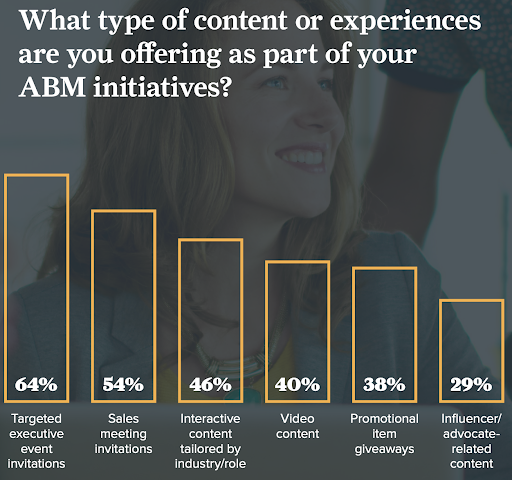
Speaking of clear opportunities, I was stunned by the graph below. Among six types of content and experiences listed for ABM usage, influencer advocate-related content was last in prevalence at only 29%.  Type of Content Experiences in ABM (Source: 2019 ABM Benchmark Survey Report) As I wrote earlier this year, B2B influencers and ABM are a powerful combination. The focused nature of account-based strategies lends itself well to collaborating with subject matter experts who are visible to, and trusted by, the prospects you most want to engage. When you know specifically who you’re trying to reach, you can confidently identify niche influencers that your audience is likely to recognize and listen to. Research shows that people are more likely to trust technical experts and peers in their field than brand-driven messaging.  Seeing this synergy and opportunity, I’m excited for our team at TopRank Marketing to keep expanding our world-class influencer capabilities in the ABM space specifically. 

5. Quantity Is the Primary Measurement Focus for ABM

How are B2B marketing executives measuring the success of their ABM programs? Here’s how the responses shook out:
  • Net-new accounts engaged (60%)
  • Number of qualified accounts (52%)
  • Contribution to pipeline revenue (50%)
  • Win rate (50%)
  • Pipeline velocity (46%)
  • Account engagement score (41%)
It comes as no surprise that bottom-line numbers are being prioritized over relative rate metrics. Business leaders want to see results, and considering that 69% of respondents in the survey report that their account-based efforts are meeting or exceeding expectations, it seems those results are there.

Find Your Perfect Fit with ABM

Buzzwords aside, account-based marketing is a very simple and natural evolution for B2B marketing. Whether or not you want to attach the label, virtually every business that markets to other businesses should be adhering to many of ABM’s core principles. Looking to learn more about ABM and its fundamentals? Check out this primer from our own Josh Nite: What You Need to Know to Get Started with Account-Based Marketing.

The post 5 Key ABM Trends for B2B Marketers to Track Heading into 2020 appeared first on Online Marketing Blog - TopRank®.