Monday, July 1, 2024

Why You Need an Influencer Strategy (and How to Build One)

“We want to do influencer marketing!” We hear this a lot. But it tends to come with other questions: “How do we go about it? What will go into it? And, how will we measure it?”

Sound familiar? 

It’s like when you say, I want to go on an overseas trip for vacation this year. But, where do you want to go and when? 

Your vacation planning needs to include a destination, airline tickets, accommodations and some idea of what you want to do and see. Otherwise, the vacation anxiety will set in and the exciting trip abroad may never happen.

Just like a well-planned vacation, any good influencer marketing campaign or program starts with a thoughtful strategy. About one-third (34%) of respondents in our 2023 B2B Influencer Marketing Report said their B2B influencer marketing strategy is “extremely effective.” Don’t you want to be a part of this group? There’s no reason you can’t! But jumping in without clear objectives and planning will cause a lot of anxiety and, usually, a lackluster program.

If you are considering an influencer program or campaign, you will need a strategy.  Let’s review the key elements of that strategy. 

Why influencer marketing for your brand?

Markets are crowded, and as you try to stand out from the crowd, you need new avenues to be seen by your audience. Knowing that people want to hear from people, instead of brands,  opens up the possibility for influencers to bring a more human perspective to your audience. 

Benefits of Influencer Marketing:

  • Increase brand awareness by reaching new audiences 
  • Garner trust
  • Grow credibility and brand reputation 
  • Support content and social media marketing strategies
  • Add to your brand thought leadership
  • Improve brand advocacy
  • Build long-term relationships with industry professionals

As with any good tactic, having the strategic plan to help guide your team gives a clear roadmap to follow. It will guide the way to success, much like mapping out your vacation will help you find your way in an unfamiliar land. 

Creating your influencer strategy

Are you ready to break through the content clutter with great B2B influencer content? Then it’s time to create your strategy. Similar to your overall marketing plan, a good influencer strategy will include:

  • Goals and KPIs
  • Program objectives
  • Audience identification
  • Influencer types, tiers and selection criteria
  • Outreach plan
  • Content plan
  • Reporting, measurement and optimization

Your influencer marketing strategy needs to hone in on the specifics of your approach, and who will be involved in the plan.

Setting achievable goals

Where do you plan to go on your exciting trip abroad? I might say I want to go to Bali, and then I set a goal to get there. That’s achievable, if I have the budget for the airfare and accommodations.

The same goes for a good influencer strategy. It begins with setting goals. And, with that, understanding how you achieve that goal and measure your success. 

A common goal for influencer marketing is increasing brand awareness. As mentioned, influencers bring a new audience to your messages, helping you grow awareness and share of voice in your industry. Remember, it is important to measure the current level of awareness for your brand so you can identify the changes that come from your campaigns. The key to success is setting achievable, measurable goals that aren’t shrouded in ambiguity. 

Be honest about your goals and make sure the tactics match up. If your plan says you are looking to increase awareness, but in reality you really need leads, don’t be surprised if you do not see leads coming into the funnel. Lead generation can happen, but that needs to be planned upfront with the tactics you choose. 

Helpful tip: Be sure to set benchmarks upfront, so you can accurately measure success and impact. Influencers can help you understand the results to expect from working with them. So, don’t be afraid to ask them upfront for benchmarking purposes.

Audience identification

Most brands have documentation on who their primary audience is, but you may want to narrow in on a particular segment of that audience. Documenting the audience helps you identify the right influencers. It also helps the influencers understand who they are trying to reach.

Influencer types, tiers and selection criteria

Who do you want to engage with for your influencer program? 

Strategy development is a key time to review the type of influencer you will want to reach out to for involvement in your campaign. This is not the time to create a full list of influencers. Instead, set your focus by deciding if you want to include thought leaders, niche experts, practitioners or internal influencers, and what percentage of the total for each profile. 

This is also a time to set your selection criteria. Beyond the type of influencer, what do they need to be talking about? What can’t they be talking about? What platforms are they active on? These are just a few of the questions you should address in the strategy. 

And, don’t forget to consider employees or executive leadership into your mix. Social media posts from employees, that are personalized, generate 64% more engagement than brand content. Plus, the clickthrough rate on the same piece of content is two times higher when it’s shared by an employee versus a company according to Business2Community

Don’t forget to account for word of mouth!

Have you ever had a friend come home from an amazing vacation, and then you find yourself planning to go to the same location on your next trip? They were a fan of that amazing place, and now you want to be a fan, too. 

Who are your brand’s fans? Consider adding your clients and customers as part of your influencer mix. Finding advocates or fans is more authentic and impactful for your potential clients.

Outreach plan

How will you connect with potential influencers? Even though you don’t yet have your final list of influencers, you need to think strategically about how you will engage them. 

Some questions to address with your outreach:

  • How will you contact the influencers? 
    • Are you building in time to understand who they are and how to nurture them in advance? 
    • What channels will you use?
  • What are the key points that your outreach message includes? 
  • What are you asking the influencers to do? 
  • Who will be doing the outreach? 
  • How will you keep track of the correspondence and activations? 

This is a good time to recognize the value of an influencer brief, and plan for that creation before you contact the influencers. 

Content planning

Depending on your objectives, the tactics and types of content you include may vary. But this is a great time to work through themes as well as the look and feel of the content. Design is important for any brand content. It is also a nice share if you plan to ask influencers to use any brand images. 

Content planning is the first step in developing the influencer brief. The aim is to help the influencers understand what you are asking them to create or do. 

Review and optimize

Sometimes while you are on vacation, a wonderful opportunity – like an amazing tour or a cooking class with a local chef – becomes available. Even though it was not in the original plan, you wouldn’t want to miss out on that experience. So, you adapt your vacation plans and make room for the new experience. 

As you are analyzing your influencer marketing program, you will often find new opportunities along the way. Or you might see that a particular tactic is not working, so your team pivots. Understanding this upfront is key, so the team is prepared to stay agile and take advantage of the learnings as the program unfolds.

Through measurement and reporting reviews, you can see patterns and actions that lead to your desired outcomes. Be ready to ideate on your plan and consider your next steps. 

Measurement metrics you can use to track the success of your influencer marketing campaign may include: engagement rates, website traffic, and conversions. Use tools like Google Analytics and social media insights to gather data. 

Is your B2B influencer marketing strategy ready to take off?

Now that you have your plan of action, it’s time to go! The vacation anxiety is gone because you know exactly how your vacation should play out. 

The same goes for your influencer program. The plan is in place and that strategy will guide you to success. 

Need help with your influencer marketing strategy? Check out our services and let our team of experts guide you to high-flying success. 

The post Why You Need an Influencer Strategy (and How to Build One) appeared first on TopRank® Marketing.

Wednesday, June 26, 2024

What Makes B2B Thought Leadership Actually Work?

B2B thought leadership shows potential buyers that your brand is a credible authority. It helps keep you top of mind even when a buyer isn’t in market yet. Essentially, it earns equity that will mature into sales and repeat business.

The 2024 Edelman-LinkedIn B2B Thought Leadership Impact Report shows that thought leadership is more crucial now than ever. The report says that 90% of decision makers are more likely to be receptive to sales and marketing outreach from companies that produce high-quality thought leadership. More than half of CEOs and other decision makers spend an hour or more per week reading thought leadership content.

But there’s a catch: The overall quality of thought leadership isn’t filling these decision makers’ hunger for new and useful ideas. Only 15% of those surveyed said the quality of thought leadership they read is “very good” or “excellent.” This represents a major opportunity to do thought leadership better than your competition.

What Makes B2B Thought Leadership the Most Effective?

The term ‘thought leadership’ can mean everything from ‘scrupulously sourced original research’ to ‘an opinion article from our CEO.’ Here’s how to make sure yours fits your potential buyer’s definition of great thought leadership.

What is B2B thought leadership?

B2B thought leadership is content created to showcase a company’s unique insights, ideas and best practices. It’s intended to provide meaningful value to a specific audience in order to build relationships with potential buyers.

You can contrast thought leadership content with:

  • How-to/educational content (practical but not necesssarily insightful)
  • Entertainment content (Engaging but not useful from a business standpoint)
  • Promotional content (intended to promote your solution’s benefits and features)

What business purposes does B2B thought leadership serve?

At first glance, thought leadership seems like a purely top-of-funnel tactic. But when it’s executed properly, it can affect business outcomes all the way through the buyer journey. It can:

  • Build share of mind. Research shows that 95% of your potential buyers are not in-market at any given time. Thought leadership keeps your brand in their thoughts until they’re ready to research.
  • Build credibility. Brand awareness is a good first step. Making sure people associate your brand with smart, novel and useful ideas is the next part of the journey.
  • Establish reciprocity. Offering value is a key way to build relationships with potential buyers. Great thought leadership is a gift that can inspire people to give back.
  • Ward off competitors. If your brand isn’t putting out quality thought leadership, you’re at risk from a brand that is. Great thought leadership inoculates your existing customers against pitches from competitors.
  • Drive more sales and premium pricing. In the Edelman-LinkedIn study, 60% said good thought leadership makes them willing to pay a premium to work with an organization, and 86% said they’d be likely to invite a thought leader company to participate in the RFP process.

With this list of benefits, it’s not hard to see why B2B companies are prioritizing thought leadership. But it takes a strategic effort to hit the mark for high-quality content that earns these results. 

Four essential elements for great B2B thought leadership

Great thought leadership can take many forms: Videos, ebooks, resource hubs, and even social media posts. Regardless of the format, these elements can elevate your thought leadership above the rest.

Cites credible data 

Original research is the holy grail of credible data; if your team has the resources to partner with a credible researcher to produce a brand-exclusive report, you’re golden.

Even if you can’t create your own report, however, you can still establish credibility through the sources you use. Look to peers in the industry, research firms like Forrester and Edelman, and public resources like government agencies to inform your thought leadership.

Includes NOVEL insights

Too often, brands forget the ‘leader’ part of thought leadership. It’s easy to write a detailed piece on the current best practices in your industry—easy enough that anyone could do it and already has.

True thought leadership should question the status quo, suggest new ways of doing things, or explore how and why the current methods are successful and how they can be optimized. It doesn’t always have to be contrarian or reactionary, but it does need to be something new.

Speaks from experience

If a grocery store clerk wrote a book about being a successful CEO, their conclusions might seem suspect. Ditto if a CEO wrote a book about being a better grocery store clerk. In either case, speculation and supposition are no substitute for actual, lived experience.

In other words, if you’re trying to write useful content for CEOs, your C-suite should be contributing their own insights. If your executives aren’t keen on writing their own content, try for at least a brief interview or two that can inform your drafting.

Is genuinely helpful

I vividly remember the first eBook I downloaded as a newbie marketer. It promised useful insights on marketing—something I desperately needed. But it was mostly platitudes and a heaping helping of brand promotion. This type of “helpful” content is all too common.

Truly helpful content begins with the intention of being helpful. Ask yourself: How will this content benefit someone who has never bought from us, and may never buy from us in the future? Starting with this question ensures your content will be useful to potential buyers as well.

How to develop a thought leadership strategy

Here’s a quick overview of how to approach thought leadership planning, conception, creation and promotion.

#1 Understand your audience

Conduct market research to understand the needs, challenges, and interests of your audience. Use keyword research, social listening, input from your customer service and sales departments, and direct customer feedback to inform your personas.

#2 Define your objectives

Determine what you want to achieve with your thought leadership efforts. Common goals include raising awareness, share of voice, engagement with thought leadership content, and even sales leads generated. 

Key metrics for top-of-funnel might include website traffic, social media interactions, new social media followers, and content shares. Lower-funnel metrics might include lead quality, the ratio of MQLs converted to SQLs, and increase in repeat business.

#3 Identify key topics and themes

A mix of internal and external sources can help ensure your content is relevant, knowledgeable and topical. Tap into the knowledge and experience of your executive and managerial teams, as well as those on the front lines with your customers. 

You can augment that internal research with external—look at competitors’ content, third-party research and social media posts from industry leaders.

#4 Create high-quality content

Outline a schedule for content creation and publication, ensuring consistency and variety in formats (blogs, whitepapers, webinars, podcasts, etc.). It’s better to publish a smaller amount of higher-quality content at a less frequent cadence than to opt for speed and quantity over quality.

It’s also crucial to ensure your content has useful, actionable advice designed to help your audience excel at their work.

#5 Engage and collaborate

One easy way to expand your reach and help establish credibility is to partner with industry influencers, guest bloggers, and other thought leaders. 

As your content earns comments and engagement, continue to interact with your audience and encourage them to participate in a dialog.  These conversations can help fuel the next round of thought leadership content.

#6 Promote across channels

It’s important that the right audience sees your thought leadership—without promotion, even the best content can fail to connect. Start by optimizing text content for SEO. Then use social media to share the content organically, and consider paid promotion for more relevant reach.

LinkedIn is most likely the best place to sponsor your content. You’re most likely to find the executive audience you’re looking for on their platform.

#7 Monitor and adjust

As with any content, it’s important to track performance and continually optimize. It’s a good idea to supplement your quantifiable metrics with actual audience feedback. 

It’s also important to make thought leadership a long-term commitment. It takes value and consistency to build credibility and stake out real estate in your audience’s minds.

Take the lead with your potential buyers

Ask anyone on the sales team: Relationship-building is a key part of turning browsers into buyers into repeat customers. Thought leadership can help kickstart a profitable relationship by showing buyers exactly who they should be working with. 

Need help with content that converts? Explore our content marketing services.

The post What Makes B2B Thought Leadership Actually Work? appeared first on TopRank® Marketing.

Monday, June 24, 2024

7 Essential Takeaways from LinkedIn’s 2024 B2B Marketing Benchmark

The most successful marketers are lifelong learners who thrive by adapting to change. And the last decade has given us plenty of opportunity to practice flexibility and adaptability. As we get used to the idea that there will be no “new normal,” we can still learn from what other marketers are doing (or not doing, for that matter).

Our client LinkedIn just published their 2024 B2B Marketing Benchmark. It’s just the kind of data we marketers need to move our art and science further. 

LinkedIn surveyed 2,000+ B2B marketers in management, leadership or executive positions to find out what teams are doing now and what they’re planning for the future.

Here are the key takeaways our team spotted.

Today, tomorrow and beyond: The future of B2B marketing  

Despite the tumultuous economic times of the past few years, the 2024 Benchmark finds marketers adapting and preparing for what comes next. Let’s dig into the data and what it means for your team’s future success.

Strategic thinking is essential

Without a continuously-developed strategy, marketers are left to react instead of act. The data shows that most marketers got that message: Over two-thirds plan to reorganize their teams this year to be more effective. 

Marketers are also carefully allocating resources across channels, with a strong focus on digital. In fact, of the top five most valuable channels, only one (trade shows/live events) is non-digital. 

Strategic marketers are seeing the biggest returns from:

  • Social media
  • Events
  • Email

However nearly half of marketers plan to increase investments in video, influencer content and case studies in the coming year. It’ll be intriguing to see how these investments paid off, when we’re looking at next year’s data.

All this strategizing is paying off: a whopping 90% said they feel good about their ability to drive revenue. This confidence is rubbing off on the finance department as well: 51% say their budget increased this year, and 54% expect an increase next year. Within that 54%, 18% say they expect a substantial increase.

Room for improvement: Acquisition vs. retention

CMOs report they’re spending 60% of resources on acquiring new customers, and only 40% on retention. That balance could shift in favor of retention with a focus on customer lifetime value for even better results.

Generative AI hits the mainstream

It’s hard to believe that just a few years ago, we were chuckling at AI’s awkwardness. Now it’s becoming an essential part of the marketing toolkit.

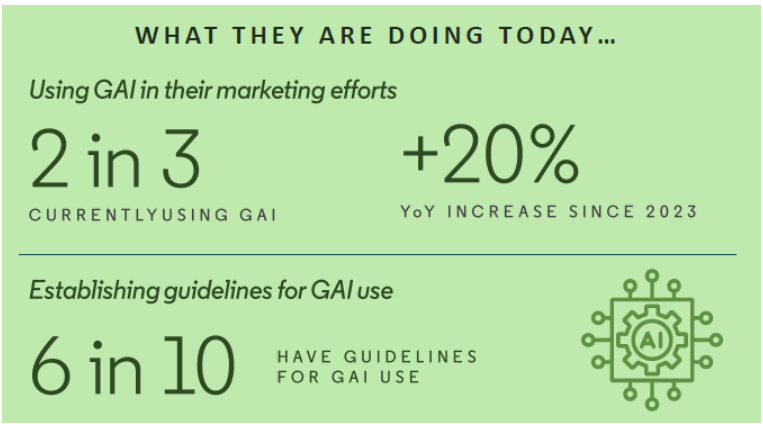
Over two-thirds of respondents said they’re using Gen AI for marketing. What’s more, over half have official guidelines for its use, and over half are actively training their teams on the technology.

It isn’t an unqualified embrace of the technology, however. Marketers report misgivings including:

  • Lack of humanity in AI-generated content
  • Risk of accidental plagiarism
  • Risk of inaccurate information

However, these misgivings appear to be outweighed by the potential benefits of increased efficiency, smarter targeting, and automated processes.

Room for improvement: Training and experience

Given how new these AI tools are, it’s not surprising that many marketers don’t feel adequately trained to get the most out of them. Of LinkedIn’s respondents, 43% say that insufficient skills are a major factor holding back adoption. And only 25% said they have an ‘extremely good understanding’ of how to use Gen AI.

Creativity is driving better results

B2B marketers are finally getting the license to be as bold and creative as their B2C counterparts. Ninety percent of LinkedIn’s survey respondents said they are advocating for bolder, more creative campaigns, including 88% of the CMOs surveyed.

These types of campaigns are intended to build brand equity by earning attention, raising awareness, establishing credibility and staying top-of-mind. Over two-thirds of respondents said they’re increasing their brand-building budget in the coming year.

Marketers agree that bold creative can lead to impressive outcomes like:

  • More brand engagement
  • Greater share of voice
  • More earned media coverage
  • Uplift in brand sentiment

Room for improvement: Adopting new tech for bolder creative

Marketers have the opportunity to embrace new channels like CTV (connected TV, like Roku and Google Chromecast) and new formats like AR and VR to take their creative campaigns to the next level.

Data is in the driver’s seat

Marketers win and lose by the quality of their data analytics. It’s not just having the right data — it’s being able to glean insights from that data and act on it. 

It’s worth noting that data skills are in top demand for marketers: “Data Analysis” ranked #1 among top digital skills added to LinkedIn profiles globally, and “Analytics” was the sixth-most in-demand skill overall.

Most of LinkedIn’s respondents say they’re on the right track with data and measurement. Seventy percent say they have the right tech to measure marketing activities, and 82% say they can demonstrate the impact of their marketing to the C-suite. Only 6% reported they could not prove their results.

Even with a high degree of data confidence, marketers are still feeling pressure:

  • To prove ROI in too short a time
  • To measure activity between buyer stages
  • To deliver metrics that show bottom-line value of marketing
  • To collect and analyze data across applications and platforms

Room for improvement: Consolidate data for deeper insights

Marketing teams still tend to work in silos, with data stored in different platforms, applications, even in different cloud providers. Bringing data together is a crucial first step to generating better insights.

Interdepartmental alignment is indispensable

Sales and marketing teams are finally doing the hard work of aligning on shared goals, KPIs and terminology. 

Alignment is a crucial part of increasing efficiency and improving results; it means less time spent arguing about what a sales-qualified lead means, and more time reaching people with the right messaging.

Only 10% of those surveyed said there is no sales and marketing alignment in their organization. More than half said there are at least some synergies between departments.

Room for improvement: Communication skills

Communication is the top skill that B2B marketers are seeking to add to their resumes. The ability to communicate clearly and professionally is a learned skill, not an inherent trait, and it’s well worth marketers’ time to learn it.

The CMO role is expanding and evolving

Part of the Benchmark focuses on how CMOs are facing challenges and preparing their departments for the future. But it’s not just about managing marketing: The CMO’s sphere of influence is growing. 

Seventy-five percent of CMOs say they are trying to involve more C-suite members in decisions, and 90% say relationship building is essential to succeed. Overall, 69% say their role has grown in importance over the last year.

CMOs reported a number of fundamental changes to their position:

  • More direct role in driving revenue
  • Expected to collaborate with the executive suite
  • Demonstrating marketing impact to bottom line
  • Helping drive strategy and budgeting for the company, not just the marketing team

Room for improvement: Balancing long and short-term goals

Marketing strategies like SEO and brand building are long plays; if you try to measure ROI too soon, it will look like they’re ineffective. CMOs need to develop their storytelling skills to argue the benefits of a long- and short-term goal balance. After all, without upper-funnel activities like brand building, there won’t be a bottom of the funnel to market to.

Diversity, equity and inclusion is a major focal point

It’s clear that diverse marketing teams are better at reaching diverse audiences. Diversity includes gender, age, ethnicity, race, religion and more. 

The news on DEI is mostly positive: 80% said their teams are gender diverse, and 75% said their teams are racial and age diverse. And leaders are still investing for the future, with 60% of CMOs saying their investment in DEI has increased in the past year.

Room for improvement: Diversity in hiring

The one sour note for DEI: Only 7% say they prioritize DEI when hiring. Building a diverse and inclusive environment starts with hiring practices; when DEI isn’t a priority, hiring will inevitably reflect bias.

What’s next for B2B marketing?

The 2024 B2B Marketing Benchmark shows impressive progress in the art and science of marketing. More data-driven strategy, bolder creative, more collaboration and diversity—the future looks bright. 

For the year to come, marketing leaders say they’re focusing on three key priorities/challenges:

  • Growing a high-quality lead pipeline
  • Implementing AI technology
  • Leveraging data to inform decisions and measure performance

If you need help meeting these challenges, our boldly creative, data-driven agency is here to help. Contact us today to get started.

The post 7 Essential Takeaways from LinkedIn’s 2024 B2B Marketing Benchmark appeared first on TopRank® Marketing.
Thursday, June 20, 2024

Competitive Intel: Here’s What an SEO Competitor Analysis Tells You

Search engine optimization (SEO) is a competition. For any given keyword or topic, your content is battling thousands of others for limited (and constantly shrinking!) real estate.

Here’s how small the victor’s podium is: 

  • The top three organic search results receive more than 2/3rds of the clicks
  • The top result receives more clicks than the 3rd-10th combined
  • In searches with a featured snippet, the snippet has a 43% click through rate

With such a narrow target to hit, it’s not enough to optimize your content, or even your site, without comparing it to the content you’re competing against.

An SEO competitor analysis can help you develop a strong strategy that makes your content stronger and takes advantage of your competitor’s underdeveloped content and blind spots. Here’s what you need to know.

What is SEO competitor analysis?

SEO competitor analysis is the practice of evaluating the content and websites of other companies in your industry. The goal is to find opportunities for your content to better suit specific search queries. You’re looking for places where your competitors are lacking content completely for relevant keywords, and especially where they’re getting good rankings with thin content. 

How to perform SEO competitor analysis

There are multiple steps to a comprehensive competitor analysis. Some are a lot easier with tools like Semrush, but at the base level, you can begin with just your browser and Google.

Step 1: Identify competitors

This may seem like too small of a first step; if you’ve been in business any time at all, you know who you’re competing with for customers. But it’s important to identify your search competition.

Your SEO competitors aren’t just the businesses that offer similar products or services; they’re also those vying for the same keywords and search engine real estate. These can include:

  • Direct competitors: Start with your existing list of businesses in your industry who are going after similar customers. These are your direct competitors, and they’re likely targeting the same audience and keywords as you.
  • Indirect competitors: These businesses may not offer the same products or services but still compete for your audience’s attention. For example, if you sell a logistics solution, your indirect competitors could include shipping and trucking companies. Anyone who is targeting the same keywords and/or audience should be on your radar. 
  • SERP competitors: To narrow the field a little, take a look at who is already ranking in the search engine results pages (SERPs) for keywords relevant to your business. These are the ones you’re directly competing with for visibility and clicks. 
  • Keyword competitors: Use keyword research tools to identify competitors who are targeting the same keywords as you. Look for businesses ranking for your target keywords and analyze their content and backlink profiles.

Step 2: Run a keyword gap analysis

A gap analysis involves identifying keywords that your competitors are ranking for, but you aren’t — and vice versa. These gaps are untapped opportunities to capture more rankings, and ultimately more traffic. There are three types of opportunities to look for:

  • Keywords your competitors are ranking for: Use SEO tools like Semrush, Ahrefs, or Moz to identify these keywords and assess their search volume, difficulty, and relevance to your business.
  • Keywords your competitors have lost: Keep an eye out for keywords that your competitors may have lost rankings for over time. These could indicate shifts in the competitive landscape or changes in search engine algorithms. Either way, you could be able to swoop in and fill the space. 
  • Keywords without robust high-ranking content: Some of the most powerful opportunities are for long-tail keywords that have no long-form, high-quality content in the SERP. A keyword like “Logistics solutions” might be challenging to rank for, but one like “Logistics solutions for sporting goods stores” might have meager results. These represent opportunities to create targeted, high-quality content that can rank well and attract organic traffic.

Step 3: Identify your niche

Establishing your niche involves identifying the specific topics, keywords, and audience segments that align with your brand and differentiate you from competitors. Essentially, you’re choosing a smaller part of the vast search landscape to try and stake a claim on. Instead of thin content aimed at hundreds of generic queries, you can focus on a few pillar pieces written for specific keywords and topics. 

Start by defining what sets your brand apart from the competition. What unique advice or insight can you offer that your competitors can’t? What’s your area of specialization in your field? Resist the urge to think in terms of business differentiators, such as products and services. Look for the differentiators in value that your content can offer.

After these first three steps, you should have a clearer idea of what search terms you plan to target.

Step 4: Analyze the SERP for user intent

Before you start putting together a content plan, it’s important to understand the user intent behind your targeted keywords. 

Consider a blanket term like “international shipping.” Keywords including this term might have a variety of intents:

  • “International shipping rates” would be seeking a specific piece of information
  • “Trends in international shipping” would be seeking industry insight
  • “Safest international shipping providers” would be evaluating vendors to engage with
  • “International shipping fanfic competition” would be seeking information about a writing contest in which fans write about pop culture characters forming relationships.

Even if that last keyword has 10x the search volume of the others, it’s clear the intent is not a good match for your shipping logistics company. But the intent isn’t always so cut-and-dried. It’s important to look at the top-ranking content for each term to make sure it matches the presumed intent. Keyword analysis tools can provide further insight and detail around search intent.

Step 5: Evaluate competing content

You’ve looked at how your competitors’ content is ranking. Now it’s time to look at the content itself, analyzing it with human intuition. Consider these elements as you look at the content at the top of the SERP:

  • Content quality and relevance: Is the content well-written, informative, and easily skimmed? Does it provide value to the reader and address their needs and pain points? Identify areas where your competitor’s content excels and where it falls short.
  • Content format and structure: Is most of the content text, video, visual, or interactive? How is information organized and presented? Look for opportunities to differentiate your content by experimenting with different formats and structures.
  • Keyword optimization: Are they targeting relevant keywords and incorporating them naturally into their content? You can use keyword research tools to identify the keywords your competitors are targeting and assess their search volume and competitiveness.
  • Content gaps and opportunities: Are there topics or keywords that they’re not covering? Can you provide unique perspectives or additional value on existing topics? Use these insights to inform your own content strategy and create content that fills gaps and better meets the needs of your target audience.

Step 6: Analyze competitors’ backlinks

While backlinks have taken on less importance in the wake of Google’s latest algorithm updates, high-quality backlinks are still a ranking factor. It’s worth making backlink strategy part of your content planning.

Start by identifying the backlinks pointing to your competitor’s website. Use backlink analysis tools like Ahrefs, Semrush, or Moz to generate a comprehensive list of backlinks. Pay attention to their quantity, quality, and diversity.

Assess the quality of your competitors’ backlinks with factors such as domain authority, relevance, and anchor text. High-quality backlinks from authoritative websites are more valuable than low-quality backlinks from spammy or irrelevant sites.

It’s important to also look at the domains that are linking to your competitor’s website. Are they from reputable sources within your industry, or are they from unrelated websites? Analyzing the linking domains can help you identify potential opportunities for building relationships and earning backlinks from similar websites. 

Consider the link-building strategies your competitors are using to earn backlinks. Are they guest posting on industry blogs, participating in online forums, or leveraging social media for link acquisition? Understanding their tactics can inspire ideas for your own link-building campaigns.

Finally, identify any gaps or opportunities in your competitor’s backlink profile. Are there high-authority websites that are linking to your competitors but not to you? Can you create more useful content for key topics in order to earn backlinks from these sites? 

Step 7: Analyze competitors’ site experience

User experience can affect a site’s rankings. If a site is slow, hard to navigate, confusing or misleading, users will bounce. This signals the algorithm that their content shouldn’t be highly ranked. It’s worth seeing how your competitors are doing in the UX department, and how you can do better:

Start by evaluating the overall user experience of your competitor’s website. See whether it is easy to navigate, visually appealing, mobile-friendly and accessible. Consider factors such as site layout, navigation menus, font readability, and visual design elements. 

Next, see how easy it is to find what you’re looking for on the site. Can users easily find what they’re looking for, or do they get lost in a maze of confusing menus and dead-end links? Pay attention to the clarity of navigation labels, the accessibility of important pages, and the presence of breadcrumbs or search functionality.

Speed is a crucial part of user experience now. Evaluate the loading speed of your competitor’s website across different devices and internet connections. Then see whether  your competitor’s website is responsive and optimized for mobile devices, as mobile-friendliness is a key ranking factor for search engines.

Finally, take a look at the technical aspects of competitor sites. This will involve looking at the page source code. Look at meta tags, schema markup, canonicalization, and sitemap structure. Analyzing these technical SEO factors can uncover opportunities for optimization and improvement on your own site.

Use this guide to help with your analysis: What to Look for in an SEO Analysis of a Website.

From audit to action

Once you’ve completed the competitor audit, you will know:

  • What unique long-tail keywords to target
  • What type of content is performing best for these topics
  • Which keywords best match your search intent
  • Where you can earn rankings above your competitors
  • How to improve your own site experience

All of this information can help build your content plan for strategic SERP domination. 

TopRank Marketing can help you get a handle on your SEO, including competitor analysis and auditing your own site. Request a free SEO scorecard to see what we can do.

The post Competitive Intel: Here’s What an SEO Competitor Analysis Tells You appeared first on TopRank® Marketing.

Monday, June 17, 2024

What Marketers Should Know About Influencer Pods

Have you noticed familiar names popping up in the comments of every single one of your favorite accounts’ social media posts? 

Perhaps this person has an unhealthy infatuation with the creator or thought leader’s online presence, or maybe they’re a highly-trained bot. While both could be true, there’s another, more harmless possibility. I’m referring to influencer pods.

What are influencer pods?

No, influencer pods aren’t some new and trendy earbuds made exclusively for today’s top brand ambassadors. Rather, the term refers to groups of social media users who engage with each other’s content via a quid pro quo relationship. The overall gist? You like, repost, comment on my social posts, and I’ll do the same for you. It’s really that simple. 

How do influencer pods work?

How often do you see creators and thought leaders asking followers explicitly to comment, like, and repost their work? It’s not uncommon, but why issue a public call to action for engagement when you can make a concerted effort to farm engagement in a mostly private group? 

Influencer pods form and communicate on the very platforms they intend to operate on, with groups most often appearing on Facebook and even LinkedIn. However, influencer pods aren’t limited to these large, mostly public communities. Sometimes, smaller groups are moved off-platform to private apps such as WhatsApp, Telegram, Discord, and Slack.

Like an exclusive group with benefits, there are some rules. The first rule of influencer pods clubs? Don’t talk about influencer pods clubs. Just kidding, mostly. While each group of these like-for-likers differ, they share a similar set of guidelines. Usually, they’re duty-bound to engage with a certain number of pieces of content a day within a certain timeframe. Failure to do so may result in participants being removed from the engagement group

The perceived advantages of influencer pods

Users have a lot to gain from influencer pods. Let’s take a look at some of the benefits they may enjoy by participating: 

  • The algorithm advantage: While no algorithm has been completely unlocked, savvy social users noticed many social platforms prioritize content with high engagement.
  • Networking: Those in pods are often in the same industry, an obvious road to relationship building and idea sharing.
  • Reach new users: Reposts from those in the same industry can help influencers reach new, relevant audiences.
  • New opportunities: Higher perceived engagement may result in outreach from a brand that uncovered your content. 

The perceived downsides of influencer pods

Perception isn’t always reality. Users who engage in influencer pods may see diminishing returns for their efforts, along with reputational implications:

  • No likes for you: Algorithms may catch on to activity perceived as suspicious and flag content, diminishing reach and in turn engagement.
  • Is this (in)organic?: Large fluctuations in engagement from pod members may push users to ask, “Is this bot activity?” 
  • Liking “unlikeable” content:  Pod members often have to engage with content they don’t enjoy.
  • Repost mania: A feed of constant reposts, which often make it difficult for original content to be found, can be unattractive to brands and audiences. 

How to identify an influencer pod

If your brand is considering collaborating with a new creator, it’s important to know if they’re involved in an influencer pod. As of now, there’s no magical formula, nor is there a tool that can detect pod behavior across all channels. That being said, influencer marketing programs like Klear can detect pod activity on some channels. 

If you don’t want to depend on software, much can be gleaned from simply reviewing an influencer’s social media activity. On LinkedIn and X, we recommend scrolling through their profile as well as the replies/comments sections. Look for:

  • Reposts: Are they reposting several pieces of the same content from the same users? Check that user profile for similar behavior.
  • Comments: Do they engage with content from other influencers? Is it a regular occurrence?
  • Tagging: Check to see original poster is tagging multiple (in many cases several) influencers in their post.

Should you work with those participating in influencer pods?

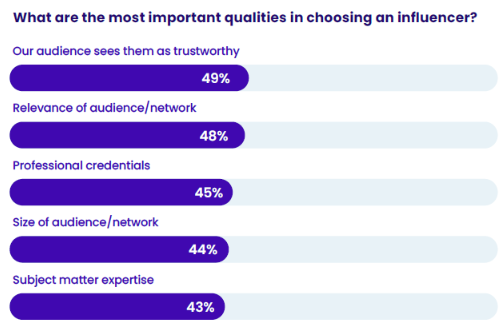
More and more audiences rely on influencers to help guide their purchasing decisions – but brands often only see meaningful results from influencers who have one key quality: trustworthiness. And marketers agree; research from our 2023 Influencer Marketing Report found that this trait is most important when choosing an influencer.

If you’re considering an influencer who appears to be engaged in an influencer pod, ask yourself, is their social presence genuine? If the way they engage with their audience feels inauthentic, what does that say about their role as a thought leader/creator? How could their activity on social media impact the image of your brand? Are they being propped up solely by coordinated engagement from their peers?

Do note that working with influencers who participate in influencer pods isn’t necessarily always a bad thing. Those who engage with others on a seemingly routine basis in an authentic manner should be considered, especially if the influencers are creating true thought leadership. At the end of the day, influencer pods can only take users so far. The road to consistent engagement and visibility starts with creating quality, authentic, and impactful content. 

Identifying and vetting influencers is an arduous task that must be done with great care, especially with the proliferation of influencer pods. Let us handle the leg work. Ask us about our influencer marketing services today and we’ll help you discover authentic influencers capable of delivering real results for your brand.

The post What Marketers Should Know About Influencer Pods appeared first on TopRank® Marketing.

Wednesday, June 12, 2024

Here’s What Healthcare Marketers Must Know in 2024

To say the past few years have been volatile for the healthcare industry would be an understatement. The COVID-19 pandemic virtually transformed how medical care is administered overnight, in ways that have proven more lasting than anyone could have anticipated. 

As the healthcare industry continues to undergo seismic changes, healthcare marketing trends naturally follow suit. 

Between lingering impacts of COVID-19, the rise of AI, data challenges, controversial interpretations of HIPAA compliance laws, and aggressive mergers and acquisitions by major companies, healthcare marketing’s evolution in 2024 will continue apace.

Keeping up with how these trends are shaping the industry and practice will be the difference between adapting or being left behind. Here are key healthcare marketing trends we’ve been monitoring and helping clients navigate.

HIPAA compliance crackdowns necessitate alternatives to third-party tracking

In December 2022, the Department of Health and Human Services Office for Civil Rights (HHS OCR) made the controversial policy decision to treat use of third-party tracking tools by hospitals and other HIPAA-covered entities as a violation of the privacy law.

In a March 2024 update, HHS confirmed that “regulated entities are not permitted to use tracking technologies in a manner that would result in impermissible disclosures of PHI [Protected Healthcare Information] to tracking technology vendors or any other violations of the HIPAA rules.”

This policy has huge implications for digital marketing because it means that many of the most common tracking technologies marketers use could be considered HIPAA violations. For example, healthcare websites using Google Analytics make themselves vulnerable to civil lawsuits. For the same reasons, retargeting pixel codes such as Meta Pixels or Google Ad codes are also now considered non-HIPAA compliant.

In the wake of this policy, healthcare marketers need to either remove all tracking from their sites or find new ways to render their ad tracking HIPAA-compliant. There are a few ways to do this:

  1. Manually ensure that your current martech stack isn’t sending PHI back to third parties 
  2. Start working exclusively with martech providers who will sign a Business Associate Agreement (BAA) with your organization
  3. Implement a Customer Data Platform you can sign a BAA with that can provide a “middleman” for data to pass to, allowing your team to ensure that PHI isn’t getting out to the third parties

While the long-term consequences of this policy on healthcare marketing are still unclear, what is evident now is that brands in this space are under heavier pressure to develop new, cookie-agnostic techniques for tracking and targeting. 

AI makes marketing personalization at scale possible

Personalizing your campaigns to your target audiences or even specific individuals and accounts has become the go-to digital marketing strategy post-pandemic. According to Gartner research, account-based marketing (ABM) provides a 28% increase in account engagement and a 25% rise in marketing-qualified leads to sales-accepted lead conversion rates, among other impressive results. 

Of course, ABM isn’t just more effective in healthcare marketing; by now, it’s practically expected. Just like patients are coming to expect more personalized service from their healthcare providers in 2024, healthcare customers likewise expect any marketing outreach they receive to speak to their unique needs and concerns.

This has presented a logistical problem for healthcare marketers: very few teams will ever have the time or resources to personalize their campaigns to the level of specificity most consumers expect. In 2024, however, there is reason to believe that AI may help solve this challenge.

As ChatGPT and other AI-powered tools like it sweep the marketing world, healthcare marketers have been quick to apply them to several aspects of their processes, from content ideation and generation to uncovering data insights. Among all of these exciting applications, one sticks out: by using AI to expedite the creation of personalized ads, true healthcare ABM at scale may become possible.

Several healthcare marketers have already begun documenting their experiments with AI as a means of scaling personalization, and their results are very encouraging. As AI technologies continue to grow more advanced and demand for ABM in the healthcare industry increases, expect to see more healthcare marketers turning to AI technology to help them expedite and deepen their personalization capabilities.

Consumers want more credible healthcare information online, and healthcare marketers are starting to notice

The fact that there’s a huge demand for health-related information on the internet is no recent trend. Even back in 2019 Google reported that a whopping 7% of its daily search traffic was health-related, meaning the search engine was fielding more than one billion health-related questions per day.

What is changing, however, is how credulous the average searcher is about the information they find. According to a study by GoodRX, 87% of participants were either concerned (19%) or strongly concerned (68%) about the spread of medical misinformation online. The study’s results found that these fears were well founded, as 70% of participants had been exposed to medical or health-related misinformation in the past.

As fears about medical misinformation continue to spread, there has been an increasing demand for high-quality, expert-verified digital health content. Healthcare marketing teams that invest in providing this kind of content are reaping the rewards: 99% of healthcare brands that participated in Semrush’s State of Content Marketing 2023 Global Report said their content marketing initiatives were proving successful.

Despite the obvious demand for credible healthcare content, however, healthcare marketers are still lagging behind when it comes to providing it. According to one study, 70% of healthcare marketing executives said they had a marketing strategy, but only 28% had it documented for continuous use and optimization.

Growth is taking place. As of 2023, 48% of healthcare teams had started to outsource their content development efforts to produce better content faster. As public trust in health information continues to erode, the demand for high-quality digital healthcare content will continue to rise. And as more healthcare marketers experience the kind of success content marketing can bring them, expect them to double down. 

Local SEO remains a major differentiator

In the world of digital e-commerce and the ease of globalized product delivery, healthcare services become one of the increasingly rare industries where location still matters. This is especially true for smaller, more localized healthcare institutions, which often have to compete with nationalized systems built out of the many large-scale mergers and acquisitions that have occurred in the 2020s.

For institutions like these, local SEO will become more important than ever in 2024 and beyond. After all, while their marketers may not be able to compete with industry titans on a national level, they can utilize the goodwill and reputation they’ve built in their own communities to differentiate.

At TopRank Marketing, we’ve helped clients navigate scenarios like these. Never underestimate the value of a thoughtful and nuanced strategy for leveling the playing field against resource-flush competitors.

The healthcare industry is only going to continue to nationalize as major players continue to acquire and incorporate smaller institutions into their growing empires. As smaller marketing teams face increased pressure to differentiate themselves from these encroaching competitors, expect to see them turn toward highly-informed and data-tested local SEO strategies like the one TopRank successfully implemented for our client.

Did we miss anything? What else have you noticed happening in the world of healthcare marketing, and what effect do you think it will have on your business in 2024 and beyond? If you have a challenge we might be able to help solve via specialized marketing services, we’d love to hear from you.

The post Here’s What Healthcare Marketers Must Know in 2024 appeared first on TopRank® Marketing.

Monday, June 10, 2024

Content Marketing Is Hard for SaaS Companies. Here’s How to Do It Right.

B2B SaaS content marketing can be notoriously complex. Your SaaS company’s solutions are built to solve problems for a highly select subset of a professional audience. If you can’t find and reach this audience with your content, creating it feels like a waste of time.

No matter how niche your SaaS solutions are, however, content marketing can and will work for your brand. In a space where it can be especially tough to differentiate and be found by your audience, a well-crafted content strategy can be your key to breaking through. Let’s talk about how.

Major challenges of SaaS marketing

The SaaS industry is a hot place to be, but strategies are under a magnifying glass. Many of the key challenges that characterize B2B marketing more generally are intensified in the SaaS environment:

  • Market education: Solutions are often especially complex and innovative, driven by advancements in digital transformation.
  • Long sales cycles: Signing up with a SaaS provider is a major investment (financially and operationally), making it a heavily-scrutinized decision.
  • Acquisition versus retention: The subscription-based nature of the business model means needing to dually showcase value to new audiences while reinforcing it for existing customers. 
  • Steepening competition: New SaaS companies are popping up just about every day. McKinsey has estimated the global SaaS market could be worth $10 trillion by 2030.

How B2B SaaS companies can elevate their content marketing

There are many aspects that go into an effective SaaS marketing strategy built to address the aforementioned barriers, but content can be the underpinning of your growth engine. Follow these key tips for great SaaS content.

Don’t neglect upper and mid-funnel educational content

If you want your SaaS content marketing to make its greatest impact, high-funnel content is even more important than demand generation content.

As a B2B company, 95% of your customers are out-of-market at any time, which means you’re inherently speaking to a small potential audience with conversion-focused content.

When you focus on top-funnel, educational search terms, you can grow your audience by catching them at the beginning of their customer journey. Use your content to answer questions your target audience has about the pain points your SaaS service can solve to start building trust and memorability with this audience, even when they’re out-of-market.

When this audience is in-market, the good will your content has built will pay off. According to Gartner research, brands that audience members are already familiar with are more than twice as likely to win their business.

Embrace the specific with long-tail keywords

In niche industries, long-tail keywords are central to a strong SEO strategy. These lengthier search terms tend to encapsulate more specific levels of user intent, relating to questions and topics that might lead people to your brand or solution.

When well researched and vetted as part of a sound keyword strategy, long-tails can serve to help qualify your audience based on the questions they’re asking in search. However, they inherently tend to have lower search volume. It’s advisable to use a mix of broader upper-funnel keywords with more specific long-tail keywords, prioritizing both audience reach and relevance. This helps with addressing the nuances of market education and the complexity of SaaS sales cycles.

Use content to support customer retention by building community

As customer retention grows harder in B2B SaaS, keeping your existing subscribers around has become as important as attracting new ones.

The reasons why customers churn out of SaaS subscriptions aren’t always dramatic. A 2023 study by Abode and Incisive showed that of the 34% of customers who churned in 2022, 15% left just to get what they perceived as a better experience. 

Keeping your customers means offering them a best-in-class experience long after their initial purchase. Your content can accomplish this by helping you build an active community of your followers online.

Publishing your content is only the beginning – what happens next is even more important. Monitor how your audience interacts with content to identify new opportunities. The more you can engage your existing community of customers with your content, the more likely they are to stick around.

Leverage third-party reviews

According to a survey of over 100 B2B SaaS marketing executives by Wynter, 81% of today’s SaaS buyers consult third-party reviews when vetting software. Over half (54%) of these buyers start their vendor research by consulting these reviews. 

Proactively respond to any reviews you receive. If you receive a positive review, consider asking the reviewer if you can feature them on your site or content. Build case studies explaining why these reviews are helpful examples of what your solution can do. 

When you publish your case study, tag the featured customer to encourage them to share it, then keep a close eye on engagement. Reach out to potential customers who comment on the case study with helpful follow-up content, and you could start the kind of relationship that leads to another sale – and another review.

At TopRank Marketing, we’ve helped many SaaS companies overcome the biggest challenges in content marketing to drive big success. Learn about our services.


The post Content Marketing Is Hard for SaaS Companies. Here’s How to Do It Right. appeared first on TopRank® Marketing.