Wednesday, February 15, 2023

15+ Top Tips For B2B Marketers To Optimize & Humanize LinkedIn Profiles

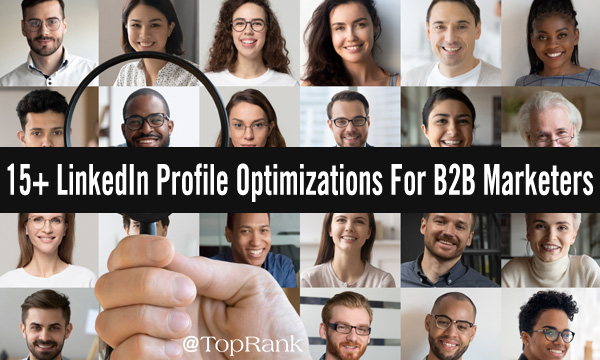
15+ LinkedIn profile optimizations for B2B marketing collage image with magnifying glass

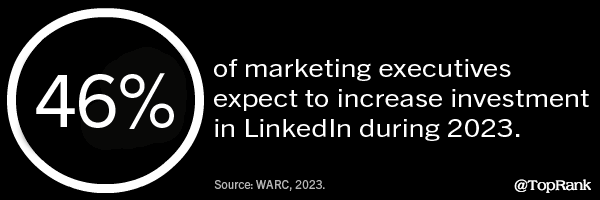
15+ LinkedIn profile optimizations for B2B marketing collage image with magnifying glass Since its formation LinkedIn* has been the leading business social media platform, and with increasing numbers of brands and users having turned away from Twitter since its 2022 ownership change and subsequent policy shifts, in 2023 LinkedIn has grown to over 900 million members. With interest in LinkedIn at a new high-point, how can B2B marketers ensure that their place within the LinkedIn universe is accurately represented — both professionally and personally? The many features of LinkedIn member profiles have evolved and greatly expanded over the years, and more B2B marketers than you would expect are missing out on exposure opportunities that are only a click away. Let’s take a look at 15+ optimizations that will take your LinkedIn profile to the next level, with a focus on the human elements that will help you sparkle on the platform.

1 — Examine & Reevaluate Your Public Profile

To begin the process of optimizing and humanizing your LinkedIn profile, take a step back and examine and reevaluate your profile as it appears to others. You can either log out of LinkedIn or choose the “Edit public profile & URL” option that is available on the top right of the desktop version of your profile, and either will allow you to take a few moments to see how your information appears to other logged-in LinkedIn users as well as to the public and to search engines. As you take a top-to-bottom run-through of your profile, perform a quick audit by making a note of any information you spot that needs to be updated, as going through our list will be a prime opportunity to take care of all of the LinkedIn profile changes you may have been postponing. This is also the perfect time to reassess which portions of your profile are public and which are visible only to your first-degree connections, your network of connections including up to three levels removed  — the friends of your friends’ friends — or to all LinkedIn members. It’s wise to periodically check these settings as your professional and personal life changes over time, to make certain that your information is as public or private as you wish.

2 — Feature The Services You Provide

LinkedIn now offers the ability to feature the services you or your organization provide in a prominent section near the top of your profile, where you can let others know the key areas in which you can provide help professionally. As with the majority of the LinkedIn profile changes we’ll be looking at, adding your services starts by clicking your “Me” drop-down before your smaller upper-right profile image and selecting the “View Profile” option. You’ll then be able to select the “Open To” button and can choose “Providing Services,” which takes you through the straightforward process of creating a service page to highlight your particular services. The service page can be as detailed or as basic as you wish, and once published your fellow LinkedIn users will be able to see the services you or your organization offer, and be able to click that section to learn more, including such options as requesting work proposals.

3 — Augment With Articles

When I joined LinkedIn in 2007 it didn’t yet have the ability to write articles beyond the length of a standard social media post, however that’s changed over the years with several methods on tap for sharing longer articles — most notably the namesake “articles” feature. One of the first things I look for when connecting with a new associate on LinkedIn — right after checking to see that they have recent activity — is whether they have written any articles on the platform itself. Oftentimes this can be a quick method to differentiate between casual LinkedIn users and those who take full advantage of its opportunities, and who in turn may offer you a more robust two-way connection. Writing an article on LinkedIn is as easy as choosing the “Write article” option below the standard “Start a post” box at the top of your content feed, and additional help is available for using the article feature. You can add a cover image, links to both on-site and off-site content, indented snippets, slide presentations, videos, and inline images, all allowing you to put together a robust article on LinkedIn. Articles are a great way to stand out on LinkedIn, and to expand the type of stories you wish to share with your audience.

4 — Turn On Creator More

Certain LinkedIn features — such as the newsletter feature and the “Talks About” hashtags we’ll explore later — can only be used when you activate the platform’s creator mode, which places an emphasis on helping build greater reach through encouraging users to follow your activity. Since creator mode can be turned on and off, you may want to try it out and see if its array of  features — including the ability to become a suggested creator to follow — suit the particular way that you use LinkedIn.

5 — Grow Your Network With A Newsletter

LinkedIn’s newsletter feature has become a greater focus for the platform over the past year, allowing users who have activated creator mode and who meet minimal audience base requirements to create and share regular newsletters within LinkedIn. Newsletters can be published at regular intervals, and allow the inclusion of media similar to the articles format we looked at previously, all automatically shared with those who have subscribed to your newsletter. Even if you have an existing newsletter in email or other formats, it can be a relatively straightforward task to also build and share it using LinkedIn’s streamlined newsletter feature.

6 — Highlight Your Offsite Writing, Digital Assets & Press Mentions

LinkedIn makes it easy to highlight digital content you’ve created elsewhere on the web, with the featured content section that allows you to share links including a thumbnail image, web-page headline, and a description of the content. This LinkedIn profile section is well worth activating to highlight work that you’re proud of, whether it's a press mention, an article you’ve written, or other content that your LinkedIn audience would benefit from. A second spot for featuring your digital assets comes in the form of a featured media section that’s available for each of your current or past work positions, which also allows you to link to external presentations, websites, videos, and documents. This can be an excellent way to showcase both your ongoing work and that which you’ve created over the years, and is available simply by adding media to each of the work experiences you have added to your LinkedIn profile.

7 — Utilize Your “Talks About” Hashtags

You may have noticed that some LinkedIn user profiles now feature a prominent listing of hashtags below their name and job title. This “Talks about” section is available to users who turn on creator mode, and allows you to showcase the topics you explore the most in the form of hashtags. Showing your relevant hashtags can be a great way to let anyone visiting your page know the areas of expertise they can expect you to post about, and is a relatively new feature that’s both easy to activate and helpful in making your profile stand out.

8 — Revisit Your Recommendations

Giving and receiving recommendations on LinkedIn have always been valuable methods to let people learn more about you, both in how you write about others and how your associates describe their work with you. LinkedIn’s written recommendation system has been a tried and true method for showcasing your work, yet oftentimes users let years pass without asking for new recommendations or taking a moment to share a recommendation about a trusted teammate or associate. Taking the time to regularly update your recommendations on LinkedIn is an especially powerful way to emphasize the personal elements or your work history, and to help your profile stand out.

9 — Add A Link To Your Website

Another relatively new LinkedIn profile addition is the ability to feature a link to either a website or content published on LinkedIn, all prominently displayed within the top introduction section of your profile. Available to those who have turned on creator mode, adding a link to your profile’s introduction section is a straightforward way to highlight your primary website or piece of content on LinkedIn. You even have the ability to choose the text — presently up to around 30 characters — that will feature the link, offering B2B marketers an enticing way to periodically highlight new initiatives.

10 — Review & Expand Your About Section

Your LinkedIn profile’s about section allows a generous about of space to share the story of your professional life, and it’s worth a look to see if you are fully utilizing the space you have available to add both nuance and detail your profile’s general information section. Even if you have a fairly robust about section, consider how it looks and whether it could benefit from being divided up in a more organized fashion, perhaps with the inclusion of visual emoji to designate specific portions of your professional story.

11 — Spotlight Your Passion Projects

Does your LinkedIn profile include a projects section? Even if you already take advantage of this profile option, it’s worth having another look at what you may not yet have listed as a project in this often-overlooked section. Available when editing your profile under the “Additional” drop-down list as “Add projects,” this category is one that can be applied to many types of past accomplishments, in-progress work, or forthcoming projects. You can create a project name, note whether it’s one you’re currently working on or give specific start and end dates, and provide a detailed description. You can also add co-creators from any of your current or past positions to allow shared team projects to be listed, and you can even include a link to the project. While you’re adding or updating your projects, it can be a good time to also look over the other accomplishments that LinkedIn allows you to feature on your profile.

12 — Stand Out With Custom Profile Imagery

Social media common sense dictates that the ideal LinkedIn profiles will feature a custom background photo header image using the latest recommended pixel size specifications — at the time of writing 1,588 pixels wide by 396 pixels tall. Your profile’s header image represents a unique way to visually tell your story, and the best ones can swiftly convey a great deal of information to a potential connection or client before a single word from your profile is taken in. Some prefer a collage of images for a background photo, while others opt for a single image. Whichever you choose, taking the time to make it pixel perfect can pay off, as can keeping the image updated over time. Additionally, if you’re broadcasting a LinkedIn Live video stream, your background photo will automatically switch to becoming a live-stream video during your broadcast.

13 — Humanize By Highlighting Your Causes

As B2B marketers look to differentiate from the rise in artificial intelligence (AI) and generative chatbot content — as we explored recently in “What Recent Data Shows About The Rising Importance of Human Touch-Points in B2B Marketing,” LinkedIn’s profile element for highlighting the causes you support takes on even greater importance. Whether it's animal welfare, arts and culture, children, education, health, or any of the other causes available, displaying those important to you can add a human touch to your LinkedIn profile should you choose to activate and use this element.

14 — Record and Display Your Name Pronunciation on Your Profile

Another easy addition to spruce up your LinkedIn profile comes when you record a short audio file that allows users to learn how to pronounce your name. Especially helpful for B2B marketers who speak at conferences or travel and network extensively for work, taking a few moments to record how to pronounce your name is a courteous touch that will also help show that you are mindful of your LinkedIn profile.

15 — Stand Out With A LinkedIn Profile Video

While rolled out some time ago, another under-utilized LinkedIn profile element is the ability to create and feature and profile video, which allows you to record or upload an introductory video up to 30 seconds in length. Presently available only from within LinkedIn’s mobile application, the profile video feature offers a goldmine of opportunity when it comes to helping others learn about you and your story.

Flip Your LinkedIn Profile To Well-Done Perfection

via GIPHY These 15+ areas represent only some of the many overall options that B2B marketers have to optimize their LinkedIn profile, yet they represent some of the areas that will provide the best reward for a relatively small time investment, and we hope that you’ll implement at least a few of the opportunities we’ve highlighted here. More than ever before, creating award-winning B2B marketing that elevates, gives voice to talent, and humanizes with authenticity takes considerable time and effort, which is why more brands are choosing to work with a top digital marketing agency such as TopRank Marketing. Reach out to learn how we can help, as we’ve done for over 20 years for businesses ranging from LinkedIn, Dell and 3M to Adobe, Oracle, monday.com and many others. *LinkedIn is a TopRank Marketing client.

The post 15+ Top Tips For B2B Marketers To Optimize & Humanize LinkedIn Profiles appeared first on B2B Marketing Blog - TopRank®.

Monday, February 13, 2023

Trust Statistics for 2023 that B2B Marketers Will Love

Top 2023 trust statistics that B2B marketers will love people jumping in front of sunset image

Top 2023 trust statistics that B2B marketers will love people jumping in front of sunset image It’s almost Valentine’s Day, that commodified and commercialized celebration of the most bountiful and free resource we have. But cynicism aside, love in all its forms is a beautiful thing worth celebrating. And one absolutely essential part of love is trust. It’s asking someone to put their trust in you and having faith you will get the same in return. That’s something no amount of flowers and chocolate can buy. As a marketer, you want customers to fall in love with your brand. But that type of love requires trust, too. And on that point, we’ve got good news and bad news. Edelman just published their 2023 Trust Barometer. It’s always an eye-opening read, and this year has some fascinating stats that marketers need to know. Here are some key takeaways from Edelman, along with statistics from a few other trustworthy sources.

5 Top Trust Stats for B2B Marketers in 2023

The past few years have shown that as trust in public institutions continues to wane, businesses become one of the few trusted entities left. That’s an opportunity for marketers, but a responsibility as well. We have to respect and reward that trust, or it won’t last.

1. Business are the only trusted institution (but that’s not saying much)

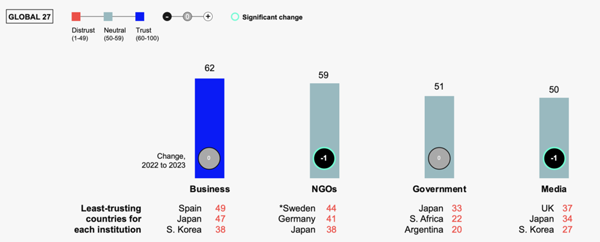
While “businesses are trusted” is a great headline, the score on Edelman’s trust barometer is only 62. That’s just two points above a neutral score. By comparison, non-governmental organizations (NGOs) are in the neutral zone with just three fewer points. Lagging further behind are government (51) and media (50), both hanging out at the low end of the neutral zone.   Edelman Chart 1 [bctt tweet="“As trust in public institutions wanes, businesses become one of the few trusted entities left. That’s an opportunity for marketers, but a responsibility as well. We have to respect and reward that trust, or it won’t last.” @NiteWrites" username="toprank"]

2. Businesses may be trusted, but their communication methods aren’t

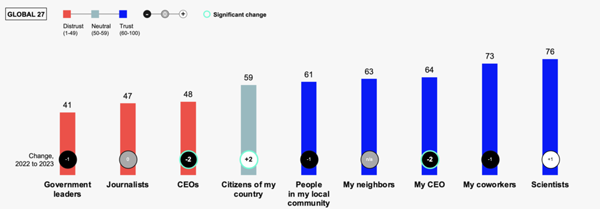
Here’s the conundrum: marketers use social media to reach audiences. But trust for social media is constantly decreasing, and consumers are abandoning platforms that they feel no longer add value. In Integral Ad Science’s Industry Pulse Report, 77% of media experts agreed that the eroding consumer trust in social media will cause them to spend less on those platforms. Facebook has the worst reputation of the major platforms, with nearly half (49%) of respondents planning to decrease spend there.  If we can’t rely on social media, why not go back to old-fashioned PR and working with journalists? According to Edelman, journalists are among the least trusted institutional leaders, with only government leaders ranking lower. Edelman Chart 2 You can see that the most trusted include “people in my community,” “my neighbors,” “my CEO” and “co-workers.” All of these are built on personal or business relationships — which means marketers should be working on building relationships, too.  In our B2B Influencer Marketing Report, 70% of our respondents said their customers rely on advice from experts or insiders. Find the influencers your customers already know and trust on a personal level, and you can help build credibility for your brand. [bctt tweet="“Find the influencers your customers already know and trust on a personal level, and you can help build credibility for your brand.” — Joshua Nite @NiteWrites" username="toprank"]

3. Reliability, transparency and responsibility build trust

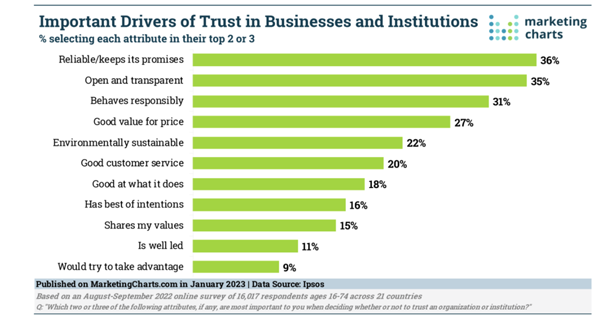
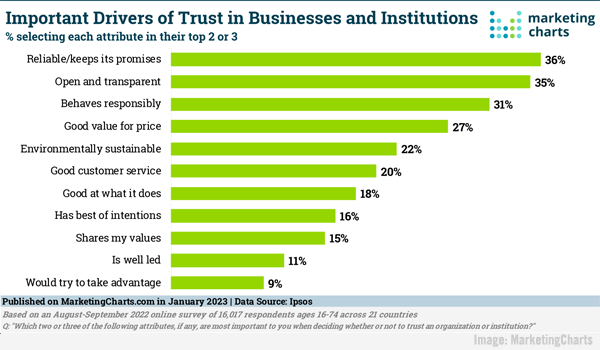
If businesses are going to hold onto that trustworthy status, we can’t rest on our laurels. Building trust is an active and ongoing process, and if we ignore it, trust will decrease over time. Ipsos just published their annual Global Trustworthiness Monitor, and asked respondents what were their top four drivers of trust. In the top three spots, ahead of “Good customer service,” “Good at what it does, and even “good value for price,” are:
  1. Reliable/keeps it promises
  2. Open and transparent
  3. Behaves responsibly
Ipsos Chart These three are especially critical in the age of mass information and citizen journalists. If a company posts about Black Lives Matter, someone (or multiple someones) can point out they have no diversity in their C-suite.  A company that pays lip service to sustainability while dumping plastics in the ocean will be found out and boycotted.  The same is true for transparency: If your company claims to be open and honest about how it deals with customer data, that claim better be rock-solid.

4. Pursue a higher purpose to build trust

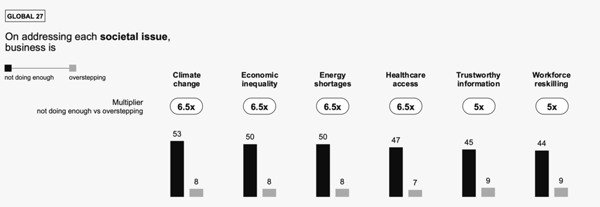
It’s tempting for brands to stay neutral on social issues in the current polarized environment. But the report shows that people not only expect brands to speak (and act) on social issues, they say brands aren’t doing anywhere near enough. Edelman asked about six pressing social issues, and for each one people were +5X more likely to say brands were not doing enough, versus overstepping. Edelman Chart 3 It’s worth noting that in particularly polarized countries (like the U.S.), the majority of people say that brands can’t avoid being political when addressing contentious social issues.  However, brands can combat being viewed as political by being a consistently reliable source of information, basing their actions on science, and acting on the same values over time. If your business has a clear purpose, consistently works to make the world a better place, and builds trust and credibility over time, you can avoid the effects of political polarization. [bctt tweet="“Brands can combat being viewed as political by being a consistently reliable source of information, basing their actions on science, and acting on the same values over time.” — Joshua Nite @NiteWrites" username="toprank"]

5. Positivity is a killer app

The content team at TopRank Marketing has a positivity policy. We want our content to be aspirational, helpful, optimistic and supportive. The days of effective marketing through negativity— fear, discontentment, anger — are over. The world is scary enough without telling someone that if they don’t buy your solution, they’ll get fired and have to live in a van down by the river.  It’s easy to see the difference in mindset. For example, compare:
  1. If your business violates privacy laws, you can end up paying millions in fines. Better get yourself a CDP.
  2. With the right data governance in place, you can personalize your marketing without worrying about compliance. Here’s how.
Positivity shouldn’t stop with content related to your solution, either. Some of the most memorable marketing campaigns remind people of their shared humanity, with optimism and hope for the future.  In Edelman’s report, 68% of respondents agreed with the statement: "Brands celebrating what brings us together and emphasizing our common interest would strengthen the social fabric.” Uniting and uplifting versus dividing and sowing fear — who knew that would help build and maintain trust, eh? [bctt tweet="“Some of the most memorable marketing campaigns remind people of their shared humanity, with optimism and hope for the future.” — Joshua Nite @NiteWrites" username="toprank"]

Now that we’ve found trust, what are we going to do with it?

The last few years have seen businesses take the lead as the most trusted societal institution. But we must admit we’ve hit that position by default: It’s the erosion of trust in government, the media, etc. that put us in the top spot. But we can still reward that trust, make good use of it, and use it to make our businesses both a better partner to customers and a better citizen of society. And that’s better than a box of chocolates any day, even Valentine’s Day. Looking for a trusted partner for your marketing? Contact us today.

The post Trust Statistics for 2023 that B2B Marketers Will Love appeared first on B2B Marketing Blog - TopRank®.
Friday, February 10, 2023

Elevate B2B Marketing News: Google’s New Bard AI, Microsoft Adds AI To Bing, Business Trust Study, & LinkedIn Content Preferences Research

2023 February 10 MarketingCharts Chart

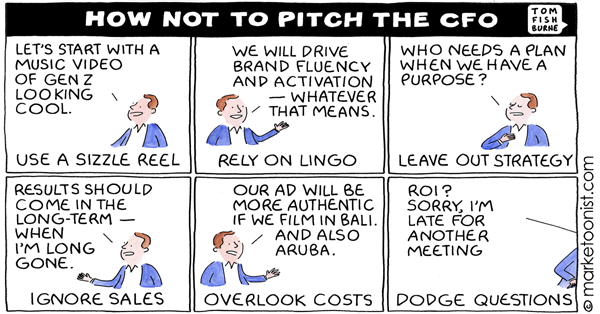
2023 February 10 MarketingCharts Chart The evolution of B2B marketing in 5 charts 55 percent of B2B marketing executives have said that the length of purchasing cycles has increased, while 35 percent of B2B marketers consider the top technology investment obstacle to be organizational data that isn’t normalized across systems — two of several findings of interest to digital marketers contained in newly-released survey data. Insider Intelligence Google shows off more of what its ChatGPT competitor Bard can do With the launch of its Bard artificial intelligence (AI) generative chatbot service, Google has signaled a search future in which it looks to temper the benefits of AI with an understanding of those areas where the technology may pose challenges, and the search giant shared examples of what its new Bard ChatGPT challenger is able to do, Google recently announced. CNBC Microsoft’s ChatGPT-powered Bing is open for everyone to try starting today Microsoft’s new AI-infused Bing search engine — based on a new Prometheus large-language model that improves upon ChatGPT — has rolled out in a limited preview for desktop users, with mobile support expected soon. New Bing features included the ability to fully interact by voice, while a corresponding new Edge browser included a chatbot sidebar, Microsoft recently announced. The Verge Google, Meta and large media agencies Havas, Horizon are increasingly focused on, and investing in, AI-powered advertising By 2027 some 90 percent of digital advertising campaigns are expected to be influenced by AI, as Facebook and Instagram parent Meta, Google, and other technology firms have increased their AI-infused advertising efforts, and DigiDay takes a look at the accompanying industry shifts. DigiDay [bctt tweet="““More advertisers are starting to say to us, ’Now we get what you’ve been saying about how AI is going to play a really crucial role in the future of content creation and also consumption for users, creators and businesses.” — @nicolamen" username="toprank"] What Types of Content Appeal to Technical Audiences on LinkedIn? [Survey] 77 percent of engineers have said that research data is of particular interest on the LinkedIn platform, followed by 73 percent who pinpointed product and service information, with industry news also representing a top content type in the sector, according to recently-published social media survey data of interest to B2B marketers. MarketingCharts Google Search's guidance about AI-generated content Google has published new best-practices guidelines that more thoroughly address the increasing use of online content either fully or partially created using generative AI, laying out new guidance on how the search giant goes about highlighting top content no matter how it has been created, Google recently announced. Google 2022 July 22 Statistics Image Twitter Tests New Quick Boost Option for Tweets Twitter has begun rolling out a new more streamlined take on the social platform's previous quick promotion option for creating paid tweet promotions, Twitter recently announced, in a move that could make it simpler for B2B marketers to boost content on the platform. Social Media Today A Tale of Two YouTubes: Ads Down, Subs Showing ‘Momentum’ as Alphabet Revenue Stalls In 2022 Google parent firm Alphabet recorded a year-over-year rise in revenue of some 10 percent, to $287 billion, up from $257 billion in 2021, with Google advertising revenue for the fourth quarter of 2022 totaling over $76 billion, while YouTube advertising revenue dropped from $8.6 billion in 2021 to $7.96 billion in 2022, Alphabet recently announced. The Wrap Using AI to analyze ads for bias—inside the new platform from Larry Adams AI has been tagged to help topple the sometimes walled garden of diversity, multiculturalism, and inclusion, as platform X_Stereotype has sought funding to expand its efforts, and AdAge recently took a look. AdAge Trust Still Relies on Reliability and Transparency A leading 36 percent of consumers have said that businesses that are reliable and keep promises drive trust, with 35 percent having pinpointed firms that are open and transparent, while 31 percent considered responsible behavior as a top factor in building trust — three of numerous findings of interest to B2B marketers contained in newly-published global trust survey data. MarketingCharts ON THE LIGHTER SIDE: 2023 February 10 Marketoonist Comic Image A lighthearted look at “Marketing to the CFO” by Marketoonist Tom Fishburne — Marketoonist Graphic Designer Saves New File as “Bane Flyer FINAL FINAL.PSD” — The Hard Times TOPRANK MARKETING & CLIENTS IN THE NEWS:
  • Lane R. Ellis — This Week in Marketing: Grace Under Pressure — LinkedIn (client)
  • Lane R. Ellis — Microwave Creativity … Can ChatGPT rival or replace human writers? Is Generative Art truly original? — Gilbreath
  • TopRank Marketing — 40+ Top Influencer Marketing Agencies in 2023 — Shane Barker
FRIDAY FIVE B2B MARKETING FAVORITES TO FOLLOW: Cara Hogan @CaraHogan27 Dave Gerhardt @davegerhardt Mary Ellen Slayter @MESlayter Juntae DeLane @JuntaeDeLane Jay Baer @jaybaer Learn more about TopRank Marketing‘s mission to help elevate the B2B marketing industry. Have you found a top B2B marketing news item for the week that we haven't yet mentioned? If so, please don't hesitate to drop us a line in the comments below. Thanks for joining us for the Elevate B2B Marketing News, and we hope you'll return next Friday for another selection of the most up-to-date and relevant B2B and digital marketing industry news. In the meantime, you can follow us on our LinkedIn page, or at @toprank on Twitter for even more timely daily news.

The post Elevate B2B Marketing News: Google’s New Bard AI, Microsoft Adds AI To Bing, Business Trust Study, & LinkedIn Content Preferences Research appeared first on B2B Marketing Blog - TopRank®.
Wednesday, February 8, 2023

B2B Search Marketing: 5 Key Ways Generative AI is Changing the Future of SEO from Google’s Bard to Microsoft’s Prometheus-Based Bing

5 ways Google's Bard and Microsoft's Bing change the future of SEO woman walking in a forest of purple flowers image

5 ways Google's Bard and Microsoft's Bing change the future of SEO woman walking in a forest of purple flowers image How is ChatGPT artificial intelligence (AI) chatbot technology changing search engine optimization (SEO), and how will the major shifts being implemented by Google, Microsoft and others alter the business marketing landscape of the future? During my 39 years working in online communications I’ve seen immense changes in search engine technology and how businesses optimize their ever-growing collections of digital content, and consider AI’s impact on the search industry to be one of the biggest shifts yet. ChatGPT — short for generative pre-trained transformer — was rolled out as a prototype in November 2022 by the OpenAI AI research organization, and takes the form of a website interface where users type in questions and receive written responses. It has been backed financially in part by Microsoft, which in January 2023 leaned into the partnership in the form of a multi-billion dollar investment over multiple years, as we covered in our weekly Elevate B2B Marketing news. Google recently announced Bard, its new experimental conversational AI service powered by its Language Model for Dialogue Applications (LaMDA) project, along with plans to use it to improve Google’s search engine, and today Microsoft has also announced its own initiative to use AI in new iterations of its Bing search engine. The way that the world engages with information is changing, and the generative AI technology Google and Microsoft are moving forward with represent a previously missing link between the roots of traditional search engines and next-level universal indexing and information presentation. Let’s take a look at five key ways that generative AI is changing the future of business search and SEO —  from Google’s new Bard to Microsoft’s latest AI-based Bing efforts, and have a glimpse at where Apple, Meta, and other leading technology firms are heading at the intersection of search and AI. [bctt tweet="“The way that the world engages with information is changing, and the generative AI technology Google and Microsoft are moving forward with represent a previously missing link.” — Lane R. Ellis @lanerellis" username="toprank"]

1 — Google’s Bard & Generative AI-Infused Search Future

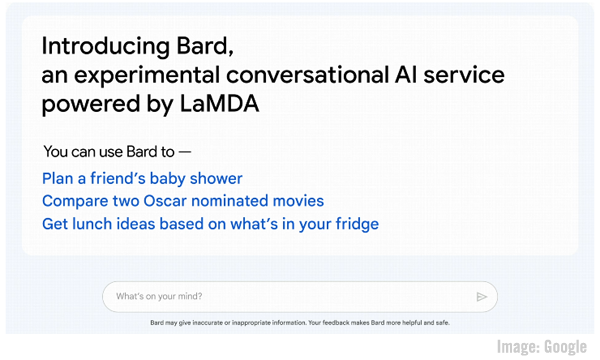
Google Bard Image With the launch of its Bard AI service, Google has signaled a search future in which it looks to temper the benefits of AI with an understanding of those areas where the technology may pose challenges. “Soon, you’ll see AI-powered features in search that distill complex information and multiple perspectives into easy-to-digest formats, so you can quickly understand the big picture and learn more from the web,” Sundar Pichai, chief executive at Google explained recently as the search giant announced plans to expand its use of AI in search, in “An Important Next Step on Our AI Journey.” When I first heard the name that Google had chosen for its AI chatbot technology my heart sank a bit, as it somehow felt like a bit of a digital slap in the face to Shakespeare, even though I suspect the teams at Google chose to use Bard with respectful intentions. Google has highlighted the power of Bard to tailor search results to an intended audience, and how more generally AI will benefit the company’s line of products. “Bard seeks to combine the breadth of the world’s knowledge with the power, intelligence and creativity of our large language models,” Pichai noted. “It draws on information from the web to provide fresh, high-quality responses. Bard can be an outlet for creativity, and a launchpad for curiosity, helping you to explain new discoveries from NASA’s James Webb Space Telescope to a 9-year-old, or learn more about the best strikers in football right now, and then get drills to build your skills,” Pichai added. The Google announcement piqued the interest of search industry professionals from journalists to B2B marketers. “I am super excited to see how this evolves at Google, Bing and others,” longtime search industry journalist Barry Schwartz recently noted in a look at the initial rollout news of Google’s Bard, in Search Engine Roundtable’s “Google Search Launches Bard, It's ChatGPT Feature, To Trusted Testers (SEOs Concerned).” “Integration of language models like ChatGPT and Bard to online content discovery and customer journeys will be having profound effects on the global e-commerce and B2B marketing landscapes,” Anoop Madhusudanan, global vice president of digital marketing and engineering at West Pharma recently noted. [bctt tweet="“Integration of language models like ChatGPT and Bard to online content discovery and customer journeys will be having profound effects on the global e-commerce and B2B marketing landscapes.” — Anoop Madhusudanan of @WestPharma" username="toprank"]

2 — Microsoft’s Multi-Billion-Dollar OpenAI & Prometheus-Powered Bing Shifts

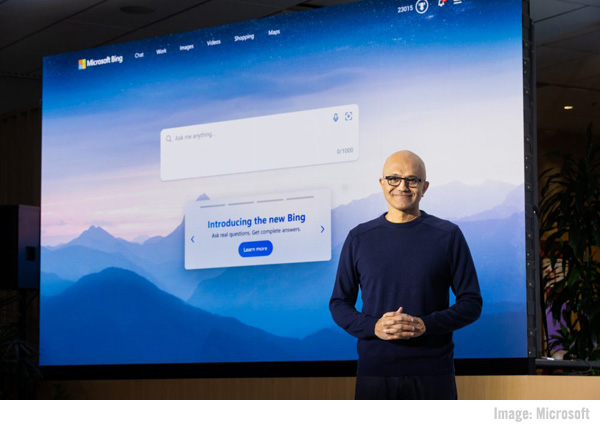
Microsoft CEO Satya Nadella image Just a day after Google’s Bard announcement, Microsoft chief executive Satya Nadella, corporate vice president and consumer chief marketing officer Yusuf Mehdi, and OpenAI chief executive Sam Altman unveiled both a forthcoming new chatbot and search hybrid Bing and corresponding Edge web browser. The two will feature a more powerful language model than ChatGPT presently uses, built specifically with search as a focus, using a new Prometheus large-language model, Mehdi also noted in Microsoft's official announcement of the new products. Microsoft’s new AI-infused Bing has rolled out in a limited preview for desktop users, with mobile support expected soon. New Bing features include the ability to fully interact by voice, while the new Edge browser includes a chatbot sidebar. If it’s seemed that ChatGPT has become nearly ubiquitous in the news cycles of early 2023, it’s for good reason, as the chatbot service recently became the fastest-growing program in history, according to UBS estimates recently noted by Krystal Hu of Reuters in “ChatGPT sets record for fastest-growing user base - analyst note,” with some 57 million unique visitors having been tallied in December 2022 alone, and now topping the 100 million monthly active users mark. Within this framework, Microsoft has sought to grow a closer partnership with OpenAI, and now to expand how the technology is used in its Bing search engine and Edge browser. “Microsoft also brings a lot of sensibilities about these things as a partner as well,” Bill Gates, co-founder of Microsoft observed in an interview with Forbes’ Alex Konrad, “Exclusive: Bill Gates On Advising OpenAI, Microsoft And Why AI Is ‘The Hottest Topic Of 2023’.” “And look, AI is going to be debated. It'll be the hottest topic of 2023, and that's appropriate,” Gates added. Nadella too shared a similarly broad outlook on how AI will affect multiple Microsoft products. "AI will fundamentally change every software category, starting with the largest category of all – search," Nadella explained. "Today, we’re launching Bing and Edge powered by AI copilot and chat, to help people get more from search and the web," he added in Microsoft's announcement. Dave Hedengren, partner data science manager, Core Search and AI at Microsoft, expressed enthusiasm for the Bing announcement. "I've never worked so long and hard on a product launch but I can honestly say that I was excited by every minute of it" Hedengren noted, adding "I firmly believe this is the next leap in learning and problem solving." The particulars of how the new Bing will affect advertising placements has yet to be seen, with Nicole Farley setting out initial takes for Search Engine Land in "Will the new Bing create more opportunities for advertisers? Maybe," while both the New York Times with its "Microsoft Throws a Coming-Out Party for A.I." and the Wall Street Journal with its "Microsoft Adds ChatGPT AI Technology to Bing Search Engine" examined the broader scope of Microsoft's newest incarnation of Bing. Microsoft’s new AI-infused Bing has its work cut out for itself, with the search engine accounting for less than nine percent of the global search market as of December 2022 — ahead of Yahoo’s 2.55 percent yet far from Google’s dominant share of more than 84 percent. Mehdi looks to begin changing this with a new generation of Microsoft search and other AI tools that act as somewhat of a digital co-pilot. "There are 10 billion search queries a day, but we estimate half of them go unanswered," Mehdi noted, adding "That’s because people are using search to do things it wasn’t originally designed to do. It’s great for finding a website, but for more complex questions or tasks too often it falls short." [bctt tweet="“AI will fundamentally change every software category, starting with the largest category of all – search.” — Satya Nadella @SatyaNadella" username="toprank"]

3 — Which AI & Search Basket Will Apple & Others Land In?

Apple to date has used Google as its default search engine for its devices and operating systems — a search placement deal dating back over a decade that has by some estimates grown to see Google paying Apple as much as $15 billion annually to keep the lucrative search agreement in place. Apple’s search, along with its Siri voice-based suggestion technology, has been the subject of ongoing speculation about eventually moving away from Google and to its own search technology, although some estimates see such a move unlikely to happen for several years, as David Price explored in Macworld’s “Apple is reportedly developing its own search engine to take on Google.” "We see enormous potential in this space to affect virtually everything we do,” Apple chief executive Tim Cook noted of AI in a recent earnings call, adding that “It will affect every product and every service that we have," as Samantha Delouya recently covered in Business Insiders’s “Apple CEO Tim Cook says AI will eventually 'affect every product and service we have'.” Along with Apple, Facebook and Instagram parent company Meta doesn’t yet have an AI chatbot path that’s been as clearly laid out as Google or Microsoft, however it certainly has ambitions of its own and has been working for years on how best to utilize the technology, as Cade Metz and Mike Isaac explored in The New York Times’ “Meta, Long an A.I. Leader, Tries Not to Be Left Out of the Boom.” Apple, Meta and other large technology companies have much to lose should they not be able to expand their AI offerings swiftly, as recent estimates suggest that by 2027 some 90 percent of digital advertising campaigns will be influenced by AI, as Seb Joseph and Marty Swant covered for Digiday in “Google, Meta and large media agencies Havas, Horizon are increasingly focused on, and investing in, AI-powered advertising.” Faced with this alongside the recent announcements of Google’s Bard and Microsoft’s new chatbot and search hybrid Bing, Apple, Meta, and other major technology firms will face increasing pressure to provide generative AI features. [bctt tweet="“We see enormous potential in this space to affect virtually everything we do. It (AI) will affect every product and every service that we have ” — Tim Cook @Tim_Cook" username="toprank"]

4 — The Missing Link of Engaging With Information

AI may prove to be search’s missing link when it comes to engaging with information. The skyrocketing use of AI chatbots may at times seem to be a radical departure from the basic tenets of search, however when looking at the big picture of how we engage with information, ChatGPT, Bard, the new Bing and the like may simply be a natural part of the ongoing transformation of search. In in the B2B sector — with its longer buying cycles and a greater number of touch-points than in the B2C world, a better search experience thanks to generative AI could be particularly welcome, as B2B buyers seek to find information about generally more complex products and services — just the type of area where Google's Bard and Microsoft's new Bing could become a differentiator. The already fine line between indexing the world’s digital information and blatantly scraping, re-mixing and publication without source credit, citation, or legal permission is likely to become an even more contentious issue however, as AI enters the mainstream of search. Sometimes gathering data for AI is done under the guise of learning or training, and when it isn’t done with legal permissions having been gathered, cases have arisen such as those brought recently by Getty Images, as Ashley Belanger explored in Ars Technica’s “Getty sues Stability AI for copying 12M photos and imitating famous watermark.” AI chatbot technology raises many legal questions relating to copyright that are likely to outpace development and implementation — as has often been the case with new technologies — yet B2B brands stand to gain an advantage by staying abreast of legal news related to AI and search. I explored some of these issues and more in “The Prompt Whisperer: ChatGPT’s Rising Reach In B2B Marketing & The AI Revolution,” and although further obstacles will undoubtedly arise, there’s no question that generative AI will forever change the face of search and optimization. [bctt tweet="“AI technology raises legal questions relating to copyright that are likely to outpace development and implementation, yet B2B brands stand to gain an advantage by staying abreast of legal news related to AI and search.” — @lanerellis" username="toprank"]

5 — Generative AI & Skyrocketing Searcher Expectations

All of the swift changes that AI is bringing to the search experience will forever alter our expectations when we use a search engine, and with this may also come a wider scope of SEO opportunities — and new challenges — that B2B brands and optimizers will need to adapt to. Searchers in Generation Alpha — Gen Z’s younger demographic cousins — will come of age in a world where AI has always existed, and where its role in search doesn’t raise an eyebrow. These young professionals will account for the next wave of B2B buyers and marketers alike, and brands that don’t adjust to the changes that AI chatbot technology is bringing to search and SEO face uncertain futures. Just how SEO professionals will need to adapt to the industry changes being brought about by the generative AI initiatives being developed by Google, Microsoft and others can’t be pinned down with any concrete certainty just yet, however there are fundamental best-practices that are almost certain to carry over into the AI era of search. Facing increasing automation from ChatGPT and other AI-infused tools, B2B marketers are also taking a closer look at our truly human touch-points to differentiate in the unique year that 2023 is shaping up to be, as we examined recently in "What Recent Data Shows About The Rising Importance of Human Touch-Points in B2B Marketing." Successful B2B optimizers will be those who can competently augment today’s SEO fundamentals with tomorrow’s generative chatbot search innovations. [bctt tweet="“Successful B2B optimizers will be those who can competently augment today’s SEO fundamentals with tomorrow’s generative chatbot search innovations.” — Lane R. Ellis @lanerellis" username="toprank"]

Generative AI Expands the Lense of SEO Possibilities for B2B Brands

via GIPHY Google’s Bard and Microsoft’s Prometheus-Based Bing are poised to usher in new and potentially better search engine experiences, and with them new SEO challenges and opportunities for B2B marketers and brands. We hope this look at some of the latest ways that generative AI is changing the future of search will help with your own efforts during what is set to be a watermark year for SEO. More than ever before, creating award-winning B2B marketing that elevates, gives voice to talent, and humanizes with authenticity takes considerable time and effort, which is why more brands are choosing to work with a top digital marketing agency such as TopRank Marketing. Reach out to learn how we can help, as we’ve done for over 20 years for businesses ranging from LinkedIn, Dell and 3M to Adobe, Oracle, monday.com and many others.

The post B2B Search Marketing: 5 Key Ways Generative AI is Changing the Future of SEO from Google’s Bard to Microsoft’s Prometheus-Based Bing appeared first on B2B Marketing Blog - TopRank®.
Monday, February 6, 2023

How B2B Brands Can Elevate Their Marketing by Aligning with Audience Passions

Elevate B2B marketing with audience passions women at laptop image

Elevate B2B marketing with audience passions women at laptop image My sister has an uncanny ability to buy the perfect present for everyone in her life. Every time she gives me a gift, I’m surprised at how thoroughly perfect it is — and most of the time, I didn’t even realize I wanted whatever it was she got me. In fact, her gift giving ability is so good that I swear sometimes she can read minds. Of course, she can’t actually read minds. No, her gift giving superpower is nothing more than listening to the people around her and understanding them. For example, she listened to me talk about my love for science fiction and my enthusiasm for getting dressed up, which made it easy enough for her to delight me with a space-themed tie clip. As marketers, we can elevate our campaigns and delight our audiences with the same simple trick. But instead of listening to stories of how they spent their weekend, we can see what they’re talking about and searching for online.

Find out what’s interesting today

According to Gartner, 84% of business leaders say customer data and analytics are extremely important for achieving their business goals. That makes sense — customer data is a glimpse into the minds of your audience that you can’t get anywhere else. But where do you find it? The best place to start is with one of the myriad of research tools available to marketers. Tools like SEMRush, BuzzSumo, and even trusty old Google Search Console have a wealth of data about search trends that can help guide the type of marketing messages, content, and experiences you provide your audience. But the tools that give you insights into search trends shouldn’t be the one and only place you look for what’s on your audience’s mind. After all, seeking the answer to a question only happens after the question is formed. And questions are only formed after a bit of conversation and contemplation — and that conversation is happening on social media. And, in 2022, there were more conversations happening on social media than ever before. This wealth of information about what’s on everyone’s minds is veritable gold for B2B marketers. And the best way to tap into those conversations and hear what people are saying is by using a social listening tool. Instead of going from site to site and scrolling through feeds hoping to glean some insights here and there, a social listening tool will give you a dashboard showcasing exactly the insights you need from across the social universe. [bctt tweet="“A social listening tool will give you a dashboard showcasing exactly the insights you need from across the social universe.” — Art Allen @punsultant" username="toprank"]

Understand your audience’s intent

Making sense of customer data remains a top challenge for marketers, according to recent research from Vericast. And it’s important not to overlook what your audience is trying to achieve, because user intent is the key dimension to unlocking B2B marketing success. In other words, it’s all well and good to know what someone is searching for — but only when you know why they’re searching for it can you give them a marketing experience that meets the need they have in that moment. And it’s that confluence of understanding a need and meeting the need that creates an effective marketing message. You can suss out user intent by using the search trend tools mentioned above, which will often give you information about a particular search term’s intent. Likewise, the social listening tools I mentioned will provide insight about sentiment within a conversation topic. Adding a qualitative dimension based on intent and sentiment in combination with A/B testing and maybe a little intuition can help you pinpoint the right message and the right call to action for your audience. [bctt tweet="“It’s all well and good to know what someone is searching for — but only when you know why they’re searching for it can you give them a marketing experience that meets the need they have in that moment.” — Art Allen @punsultant" username="toprank"]

Get creative and speak to your audience’s passions

Aligning what your audience is interested in with what they’re trying to achieve will set you up for success in giving them what they want. But simply knowing what content your audience is interested in and how they want to use it is only half the battle. To really elevate your B2B campaign, you need to embrace creativity, emotion, and humanity. One thing the B2B world is catching onto in recent years is the power of human, creative, emotion-based marketing campaigns. In fact, according to LinkedIn*, 82% of B2B marketers globally say creative confidence is growing. An appeal to audience passions rooted in humanity and empathy rather than logic, data, and outcomes has been a staple of B2C marketing since its inception. But this emotional, creative approach is gaining a foothold in the B2B world — and these sorts of campaigns are actually winning awards. When we have rich audience data and the intent behind it in hand and we put it to use with creativity and empathy, we can surprise and delight our audiences with elevated marketing experiences they didn’t even realize they wanted. For more insights into how you can elevate your own B2B marketing campaigns, follow the TopRank Marketing Blog. * LinkedIn is a TopRank Marketing client.

The post How B2B Brands Can Elevate Their Marketing by Aligning with Audience Passions appeared first on B2B Marketing Blog - TopRank®.
Friday, February 3, 2023

Elevate B2B Marketing News: B2B Gets More Customer Focused, Instagram Adds Lead Forms, Personalization Study, & ChatGPT Plus Launches

2023 February 3 Ascend2 Chart

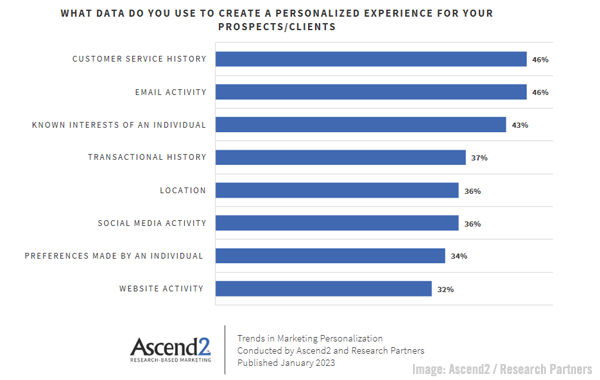
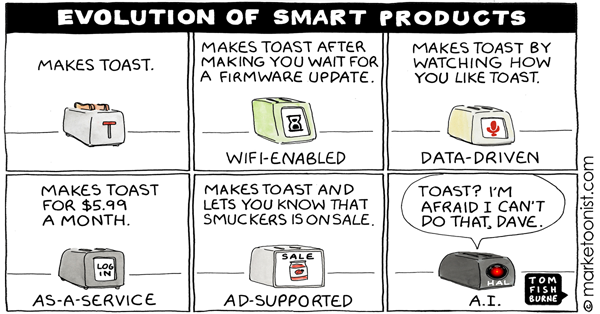
2023 February 3 Ascend2 Chart B2B marketing will be more digital, customer-focused this year [Data] Marketers will spend $6.16 billion on influencer marketing in the U.S. alone during 2023, which would be an increase of 23.4 percent over 2022, while 54 percent of B2B marketers have said that they plan to spend more on customer marketing during 2023 — two of several findings of interest to digital marketers contained in newly-published B2B marketing research. Insider Intelligence [bctt tweet="“Organizations have not been nearly as focused on measuring customer health as they should have.” — Ross Graber @RossGraber" username="toprank"] OpenAI launches ChatGPT Plus, starting at $20 per month The OpenAI artificial intelligence (AI) research organization, fresh off its recent multi-billion-dollar expanded investment from Microsoft, has rolled out a premium $20 per month version of its popular ChatGPT service — short for chat generative pre-trained transformer, featuring priority access to the generative AI service including updated features and speedier response times, OpenAI recently announced. TechCrunch CMOs Look to Hire Growth Marketers Amid Market Pressures Customer marketing, social customer care, and social media managers top the list of expected job areas that chief marketing officer (CMO) have said they are planning to hire for, with 64 percent of marketers also noting that they expect to hire paid media professionals, according to newly-released survey data. MarketingCharts Google Publishes A New SEO Case Study, This One From Vimeo On Video SEO Search giant Google has published its first industry case study in some 18 months, with its latest effort taking a look at the particulars of search engine optimization (SEO) relating to video search at digital video firm Vimeo, Google recently announced. SEO Roundtable Instagram Adds Lead Forms as CTA Button Option on Business Profiles Meta-owned Instagram has begun offering new lead form options to some of its user-base, including an array of call-to-action (CTA) features, presently limited to creator and business profiles on the platform, including custom question data collection along with standard fields, Instagram recently announced. Social Media Today Marketers Are Leaning Into Podcast Advertising: Study 65 percent of U.S. marketers have said that they expect to spend more on podcast advertising, with 83 percent of previous podcast ad buyers noting that they expect to increase their budgets, while programmatic podcast advertising is expected to nearly triple by 2027, according to newly-published survey data of interest to digital marketers. MediaPost 2023 February 3 Statistics Image Instagram's co-founders are mounting a comeback The co-founders of Instagram have been putting together plans for a forthcoming new social media platform, as it has begun accepting early applications to beta test its new Artifact platform, which seeks to explore the merging of AI, articles, and facts, and Platformer recently took a look. Platformer Which Social Media Channels are Gaining and Losing Steam? [New Consumer and Platform Data] Instagram, Facebook, YouTube, TikTok, and LinkedIn have been singled out as the social media channels that are likeliest to achieve the highest return-on-investment (ROI) during 2023, according to newly-published social media marketing channel survey data. HubSpot New Google Ads Feature: Account-Level Negative Keywords Google has updated its popular Google Ads platform with the addition of account-level negative keywords, strengthening marketers' ability to use the search term exclusion features and making campaign management more efficient, the search giant recently announced. Search Engine Journal What Data Do Marketers Use for Personalization – And How Much Access to It Do They Have? When it comes to the types of data that B2B and B2C marketers use in personalization efforts, customer service history, email activity, interests, transactional history, and location were among the top types being utilized, according to newly-published survey data of interest to B2B marketers. MarketingCharts ON THE LIGHTER SIDE: 2023 February 3 Marketoonist Comic Image A lighthearted look at the “Evolution of Smart Products” by Marketoonist Tom Fishburne — Marketoonist Wayback Machine: 5 Alternatives To Try — Search Engine Journal Elder Emo Desperately Tries Coding New Fall Out Boy Single Into His Microsoft Teams Homepage — The Hard Times TOPRANK MARKETING & CLIENTS IN THE NEWS:
  • Harry Mackin — This Week in Marketing: Big Changes, Thoughtful Responses — LinkedIn (client)
  • TopRank Marketing — 40+ Top Influencer Marketing Agencies in 2023 — Shane Barker
  • Lee Odden — 50 Inspiring Marketing Quotes to Motivate Your Marketing Team — ShareThis
FRIDAY FIVE B2B MARKETING FAVORITES TO FOLLOW: Amisha Gandhi @AmishaGandhi Ashley Faus @AshleyFaus David Meerman Scott @dmscott Jason Miller @JasonMillerCA David Berkowitz @dberkowitz Learn more about TopRank Marketing‘s mission to help elevate the B2B marketing industry. Have you come across your own key B2B marketing news item for the week that we haven't yet mentioned? If so, please don't hesitate to drop us a line in the comments below. Thank you for taking the time to join us for the Elevate B2B Marketing News, and we hope that you will return again next Friday for another array of the most up-to-date and relevant B2B and digital marketing industry news. In the meantime, you can follow us on our LinkedIn page, or at @toprank on Twitter for even more timely daily news.

The post Elevate B2B Marketing News: B2B Gets More Customer Focused, Instagram Adds Lead Forms, Personalization Study, & ChatGPT Plus Launches appeared first on B2B Marketing Blog - TopRank®.
Wednesday, February 1, 2023

The Myth of Recession-Proof B2B Marketing & 3 Things To Do Instead

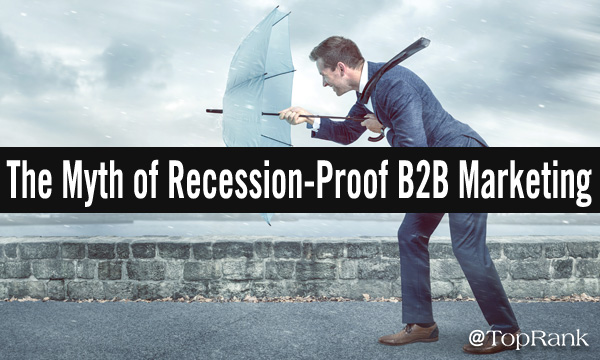
The myth of recession-proof B2B marketing businessman holding umbrella against headwinds image

The myth of recession-proof B2B marketing businessman holding umbrella against headwinds image Is recession-proof marketing genuinely possible in the uncertain headwinds of 2023, and — if not — what can B2B marketers do instead to best weather the storm? Recession-proof B2B marketing may sound reassuring, however blindly buying into it could at the very least cause unwanted surprises, and at the worst end up proving disastrous. Thankfully, there are marketing tactics that persevere better than others during uncertainty, however none will be quite the digital panacea that some have been recently touting. 97 percent of chief marketing officers and brand managers have said that inflation and recession concerns were a top concern when it comes to what keeps them awake at night, according to the most recent “Marketing on My Mind” survey — concerns that were new to the 2022 edition of the list. “Marketers must make the case to the C-suite that a recession may actually be the most opportune time for brands to double-down on ad spending and seize market share,” Chuck Kapelke recently observed in the Association of National Advertisers (ANA) look at “How Marketers Avoid Potholes in the Road Ahead.” [bctt tweet="“Marketers must make the case to the C-suite that a recession may actually be the most opportune time for brands to double-down on ad spending and seize market share.” — Chuck Kapelke for @ANAmarketers" username="toprank"] Let’s take a look at three helpful things B2B marketers can do to positively address economic shifts while placing the downturn in its proper long-term context.

1 — Tap Trust & Authenticity

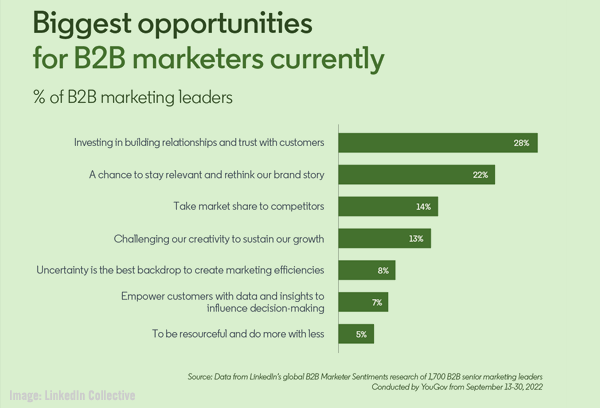
One straightforward way to armor your B2B marketing against recession-derived threats is to tap into the fundamental power of trust and authenticity. Building trust with customers has seen an increased focus among B2B marketers. “B2B marketers see this time as an opportunity to invest in building relationships and trust with customers (28%), and a chance to stay relevant and rethink their brand story (22%),” Tequia Burt, editor-in-chief of the LinkedIn* Collective and the LinkedIn Ads Blog, observed in “Companies Focus on Building Brand to Drive a Faster Recovery After the Downturn.” LinkedIn Image Making an effort to better understand customers and their 2023 obstacles is another way to make the most of economic uncertainty. “Retention rates are softening, conversion rates are lessening, and there seems to be an increase in discount seeking and a more frugal mindset,” Joanna Lord, industry chief marketing officer and advisor recently noted in “The State of Consumers in 2023: The Great Disconnection.” “This will require us to deeply understand our customers — their fears, concerns, upcoming challenges and find news and authentic ways to speak to them,” Lord added. To help strengthen trust and authenticity in B2B marketing efforts, the following articles we’ve published feature tactics that can also prove especially helpful in 2023: [bctt tweet="“Retention rates are softening, conversion rates are lessening, and there seems to be an increase in discount seeking and a more frugal mindset.” — Joanna Lord @JoannaLord" username="toprank"]
2 — Hone In On A More Human Touch

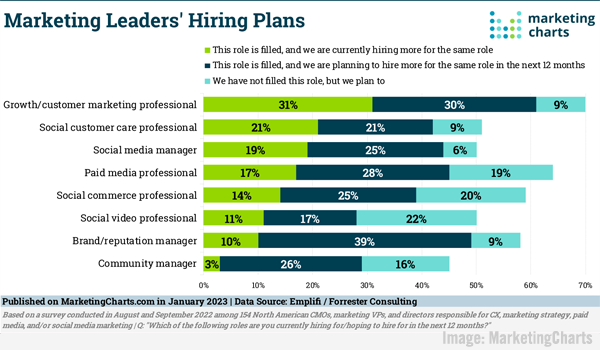
Another way that B2B marketers are successfully dealing with recent shifts in the market is by honing in on a more human touch. “Economic uncertainty has made people more discerning about how they spend. And hybrid experiences have changed the way people connect,” the team at Google’s “Think with Google” recently observed as part of a look at its annual “Year in Search” report. When it comes to the people who are creating the human touches in B2B marketing, we can glean some insight by looking at which jobs chief marketing officers are hiring for. Growth and customer marketing, social customer care, and social media managers topped a recent Forrester list of expected CMO hiring. MarketingCharts Chart The marketing professionals in these roles are in demand partly due to an increased demand for people who can create personalized digital experiences that humanize B2B brand experiences, and achieve both new customer and subsequent revenue growth. 32 percent of global business decision-makers have said that they are considering increasing marketing and sales activity over the next six months in order to help counteract economic uncertainty, according to recently-published survey data. Our always-on digital work life has led increasingly to burnout for marketing executives and B2B customers alike, and fueled a shift to valuing fewer but closer brand relationships. “There’s an increasing desire among customers to have fewer relationships and deeper relationships with brands — and relationships that are more tailored to their specific wants and needs,” Andrew Frank, research vice president at Gartner recently observed. Being able to persevere through challenging times is a hallmark of successful B2B marketers, which has led some to embrace the term "all weather marketing." "'All Weather Marketing' is about having the resolve to remain steady and committed to your investment for the longer term, even as outside circumstances change," Ty Heath, director of market engagement at LinkedIn's B2B Institute recent examined in "Want to Drive Growth Next Year? Embrace All Weather Marketing." [bctt tweet="“'All Weather Marketing' is about having the resolve to remain steady and committed to your investment for the longer term, even as outside circumstances change.” — Ty Heath @Tyrona" username="toprank"] In the face of record levels of content created either partially or entirely by artificial intelligence (AI) chatbot and related technology, the importance of human touch-points in B2B marketing is likely greater now than ever, and we’ve published several looks at humanizing efforts that marketers can make:
3 — Invite Influence & Lean Into Purpose

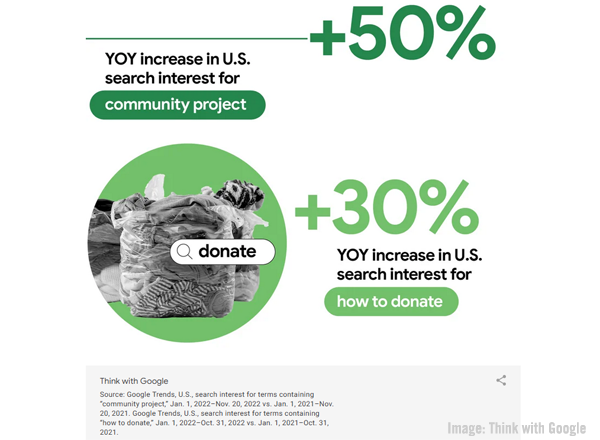
The third key element that transcends the notion of recession-proof marketing comes when we invite greater purpose and make a conscious effort to lean into purpose. “Over the past few years, we’ve seen an uptick in more purpose-driven marketing,” Chris Byrne, president of marketing strategy and brand at UPS recently noted. “However, today’s uncertain economic environment has many brands balancing tightening budgets with the need to drive growth. My prediction is that brands that stay the course with their purpose-driven marketing efforts will see dividends paid once we weather today’s economic storm. Purpose and profitability don’t need to be at odds with one another – in fact, when executed together, they can create an even bigger impact,” Bryne added. [bctt tweet="“Brands that stay the course with their purpose-driven marketing efforts will see dividends paid once we weather today’s economic storm.” — Chris Byrne of @UPS" username="toprank"] “We know that recommendations from people we know, and trust directly, influence how we spend our time and money,” Doug Frisbie, vice president of global business marketing at Snap suggested recently in the same piece as Byrne. “Brands that capitalize on that influence successfully through their marketing strategies stand to win new customers and market share,” Frisbie also observed. Leaning into purpose during economic uncertainty can help B2B brands share the type of personal digital stories that stand out in 2023. “Building trust with neighbors is a key part of brand storytelling today. Ads no longer say it all; a company’s actions say much more,” Sadie Thoma, director of U.S. ads marketing at Google recently observed. Google Image Brand purpose is poised to see growing importance in 2023, with 72 percent of B2B buyers having said that they are more apt to purchase from socially responsible companies, as we covered in our Friday Elevate B2B Marketing News. [bctt tweet="“Brand purpose is no longer something you just message. It’s how that purpose is activated by the people inside the brand and received by people who buy it.” — Max Lenderman @MaxLenderman" username="toprank"] Purpose and influence go hand-in-hand, and in the following articles we’ve explored how to make each work better both separately and in tandem: [bctt tweet="“Brands that capitalize on that influence successfully through their marketing strategies stand to win new customers and market share.” — Doug Frisbie @DougFrisbie"

B2B Marketers Can Armor Up During Digital Downturns

via GIPHY By tapping into trust and authenticity, honing in on a more human touch, inviting greater influence and leaning into brand purpose, B2B marketers may not be able to craft 100 percent recession-proof work, however they will have the important digital armor necessary to positively address economic uncertainty and become all weather marketers. Our current social media poll asks B2B marketers which business marketing tactic will be closest to recession-proof during 2023, and you can vote on both our LinkedIn and Twitter profiles. We hope our myth-busting look at recession-proof B2B marketing will help with your own efforts in 2023 and beyond. More than ever before, creating award-winning B2B marketing that elevates, gives voice to talent, and humanizes with authenticity takes considerable time and effort, which is why more brands are choosing to work with a top digital marketing agency such as TopRank Marketing. Reach out to learn how we can help, as we’ve done for over 20 years for businesses ranging from LinkedIn, Dell and 3M to Adobe, Oracle, monday.com and many others. * LinkedIn is a TopRank Marketing client.

The post The Myth of Recession-Proof B2B Marketing & 3 Things To Do Instead appeared first on B2B Marketing Blog - TopRank®.